
Anyone can raise a portfolio’s yield. Just buy riskier bonds. The real question - the one that separates thoughtful investors from yield-chasers - is whether you’re being adequately paid for the risk you’re adding.
Owning a few good bonds is not the same as owning a good bond portfolio. A collection of individually attractive holdings can still be fragile if they’re all exposed to the same risk - the same issuer, the same sector, the same point on the yield curve, the same moment of illiquidity. Portfolio construction is the discipline of assembling bonds so that the whole is sturdier than any of its parts.
This is the capstone. It assumes you understand yields, duration, ratings, and the macro cycle, and it shows you how to put them together into a structure that earns a sensible return for the risk it takes - which is the only kind of return worth pursuing.
The core idea: return per unit of risk
Anyone can raise a portfolio’s yield. Just buy riskier bonds. The real question - the one that separates thoughtful investors from yield-chasers - is whether you’re being adequately paid for the risk you’re adding.
This is risk-adjusted thinking, and in fixed income it has a specific, measurable anchor: the credit spread.
Credit spreads: the price of taking risk
A credit spread is the extra yield a bond offers over a government bond of the same maturity. If a 5-year government bond yields 6.8% and a 5-year AA corporate bond yields 8.3%, the credit spread is 1.5% (150 basis points). That spread is your compensation for taking on the corporate’s default risk instead of lending to the sovereign.
Spreads are the heartbeat of credit investing, and reading them is a genuine skill. A few principles:
Spreads widen when fear rises and narrow when confidence returns. In calm times, investors accept slim spreads because defaults feel remote. When stress hits - a sector wobbles, liquidity dries up, a large issuer defaults - spreads blow out as investors suddenly demand far more compensation for the same risk. This means spreads are partly a sentiment indicator, not just a fundamentals one.
A wide spread is either an opportunity or a warning - and telling them apart is the whole game. When spreads are historically wide, you’re being paid generously to take credit risk, which can be an excellent entry point if the underlying issuers are actually sound. But spreads sometimes widen because the market has spotted real deterioration you haven’t. The discipline is to ask: is this spread wide because of temporary fear, or because something is genuinely wrong?
Compressed spreads are a quiet danger. When spreads are unusually tight, you’re taking corporate risk for almost no extra reward over government bonds. That’s often the worst time to reach for credit - you bear the full downside (defaults, downgrades, spread widening) for a sliver of extra yield. Paradoxically, the moments when credit feels safest are often when it’s least well-compensated.
Here’s the mental model in a table:
Spread environment | What it usually means | Sensible posture |
|---|---|---|
Very wide | Fear elevated, generous compensation | Selectively add quality credit - but verify fundamentals |
Normal | Balanced pricing | Standard diversified exposure |
Very tight | Complacency, thin compensation | Reduce credit risk; favour government/high-grade |
The key insight professionals internalise: you want to add credit risk when you’re being paid well for it (wide spreads) and reduce it when you’re not (tight spreads) - which is the opposite of what most investors, driven by comfort and recent returns, instinctively do.
Spread analysis in practice
Reading spreads well means looking at more than a single number.
Compare the spread to its own history. A 150 bps spread means little in isolation. Is that wide or tight for this issuer, this rating, this sector? Spreads should be judged against their own historical range, not an absolute yardstick.
Watch the direction of travel. A spread that’s widening on a specific issuer while peers hold steady is a red flag - the market may be pricing in trouble before the rating agencies react. Ratings lag; spreads lead. An investor who watches spreads gets an earlier warning than one who watches ratings alone.
Distinguish issuer-specific from market-wide moves. If every spread widens together, that’s a macro risk-off event, and it can create opportunities in perfectly healthy issuers caught in the downdraft. If one issuer’s spread widens alone, that’s specific trouble worth investigating before you touch it.
Respect the rating gradient, but don’t outsource judgement to it. Moving from AAA to AA to A to BBB, spreads widen at an accelerating pace, because default risk rises non-linearly. The jump from BBB to below-investment-grade is especially steep, because many institutional investors are barred from holding sub-investment-grade paper, thinning the buyer pool. Understand where the cliffs are.
Diversification: the only genuine free lunch
The famous line that diversification is the closest thing to a free lunch in investing applies with special force to bonds - because the downside of a single credit event is so asymmetric. When a bond defaults, you don’t lose a few percent; you can lose most of your principal. One default can erase the extra yield from dozens of good bonds. That asymmetry is why concentration is so dangerous in credit and why diversification matters more here than in many other asset classes.
Diversify along several axes at once:
By issuer. Never let one borrower dominate. A common discipline is capping any single non-government issuer at a modest percentage of the portfolio, so no one default can inflict serious damage.
By sector. Bonds from the same industry tend to get into trouble together (think of a sector-wide shock hitting several finance companies at once). Spread across unrelated sectors.
By rating. A blend across the quality spectrum lets you balance safety and yield, rather than betting the portfolio on one rung.
By maturity. This is where laddering re-enters - staggered maturities diversify your reinvestment timing and your rate-risk exposure.
By instrument type. Government securities, PSU bonds, corporate bonds, and other instruments behave differently across cycles; holding a mix smooths the ride.
The goal isn’t to own a little of everything for its own sake. It’s to ensure that no single thing going wrong - one issuer, one sector, one bad reinvestment moment - can seriously wound the portfolio.
Duration structure: bullet, ladder, or barbell
How you distribute your holdings across maturities is a strategic choice with three classic templates. Each expresses a different view and serves a different goal.
The bullet. Concentrate maturities around a single point - say, all bonds maturing in roughly 7 years. This suits an investor with a specific future liability to fund (a child’s education, a planned purchase). It’s precise but concentrated in its rate-risk exposure at that one horizon.
The ladder. Spread maturities evenly across a range, as covered earlier. This is the workhorse for steady income and reinvestment flexibility, and it makes no strong bet on the direction of rates. It’s the default for most income-focused investors who want resilience over cleverness.
The barbell. Hold a cluster of short-maturity bonds and a cluster of long-maturity bonds, with little in the middle. The short end gives you liquidity and quick reinvestment ability; the long end gives you yield and price appreciation potential if rates fall. The barbell is more of an active stance - it tends to outperform when the curve moves in particular ways and lets you adjust each end independently.
Structure | Best for | Rate-view expressed | Trade-off |
|---|---|---|---|
Bullet | Funding a known future need | Neutral, horizon-specific | Concentrated at one maturity |
Ladder | Steady income, resilience | None (rate-agnostic) | Rarely optimal, always robust |
Barbell | Active positioning | Views on curve shape | Needs more management |
Which you choose flows directly from the macro read of the previous article. Expecting an easing cycle and a steepening curve? A barbell with a meaningful long leg can capture the gains. Uncertain and income-focused? The ladder asks nothing of your forecasting ability and rarely lets you down badly.
The core-satellite framework
A practical way to assemble all this is the core-satellite approach, which most disciplined bond portfolios resemble whether or not they name it.
The core - the larger share - holds high-quality, liquid, defensive bonds: government securities, top-rated PSU bonds, and AAA corporates. Its job is capital preservation and steady income. It’s the ballast that keeps the ship upright.
The satellites - a smaller, deliberately-sized share - hold higher-yielding, higher-risk positions: lower-rated (but researched) corporate bonds, or tactical duration bets based on your macro view. Their job is to lift overall return, and they’re sized so that even if a satellite fails entirely, the core absorbs the blow.
The elegance of this structure is that it lets you take considered risk in a contained way. You’re not betting the whole portfolio on your best idea; you’re letting a controlled slice express it while the core protects you. An HNI with a large fixed-income allocation might run a substantial defensive core with a handful of carefully-chosen satellites, each capped in size, rather than a flat sprawl of similar-risk bonds.
Liquidity: the risk everyone underestimates
Here is the factor that separates textbook portfolio theory from Indian market reality, and it deserves blunt honesty: large parts of the Indian corporate bond market are illiquid.
Government securities trade actively and can usually be sold reasonably close to fair value. But many corporate bonds - especially lower-rated ones, smaller issues, and privately placed paper - trade thinly or barely at all in the secondary market. You can buy them easily enough; selling them before maturity at a fair price is another matter. In stressed conditions, the buyers can simply vanish, and you may face a painful choice between holding to maturity or selling at a steep discount.
This has hard implications for how you build a portfolio:
Match liquidity to your actual needs. Money you might need on short notice should sit in genuinely liquid instruments - government securities or highly liquid, top-rated bonds - not in a high-yielding but thinly-traded corporate bond, however attractive its coupon.
Treat illiquid bonds as hold-to-maturity commitments. If you buy a thinly-traded bond, plan to hold it to the end. Don’t count on selling it midway; assume you can’t.
Demand a liquidity premium. An illiquid bond should pay you extra specifically for its illiquidity, over and above its credit spread. If it doesn’t, you’re not being compensated for a real risk you’re taking.
Remember that liquidity is fair-weather. A bond that trades fine today can become untradeable precisely when you most want to sell - during market stress, when everyone heads for the exit at once. Never assume today’s liquidity will be there tomorrow.
Recent structural improvements - the reduction of face values to as low as ₹10,000, SEBI-regulated online bond platforms, and the routing of orders through exchange quote systems - have genuinely improved retail access and transparency. But access and liquidity are not the same thing. Being able to buy a bond easily doesn’t guarantee you can sell it easily. Build with that distinction in mind.
The number that actually matters: after-tax, risk-adjusted return
Pull the threads together and the target of the whole exercise comes into focus. You’re not maximising yield. You’re maximising the after-tax return per unit of risk, subject to your liquidity needs and time horizon.
That means, at every decision:
Translate headline yield into after-tax yield, using the taxation rules relevant to your holding (interest taxed at slab; listed long-term gains at a flat rate; unlisted gains treated as short-term - as covered in the intermediate taxation section, and always worth confirming against current law).
Weigh that after-tax yield against the credit risk (is the spread adequate?), the rate risk (is the duration appropriate to your view and horizon?), and the liquidity risk (can you exit if you must, and are you paid for illiquidity?).
Ensure the position is sized so that its failure wouldn’t cripple the portfolio.
A bond that clears all of those hurdles earns its place. A bond that offers a gorgeous yield but fails on tax efficiency, or concentration, or liquidity, does not - no matter how tempting the number.
A worked illustration of the framework
Consider, purely illustratively, how an investor with ₹50 lakh to allocate to fixed income might reason through a structure (this is a demonstration of the thinking, not a recommendation):
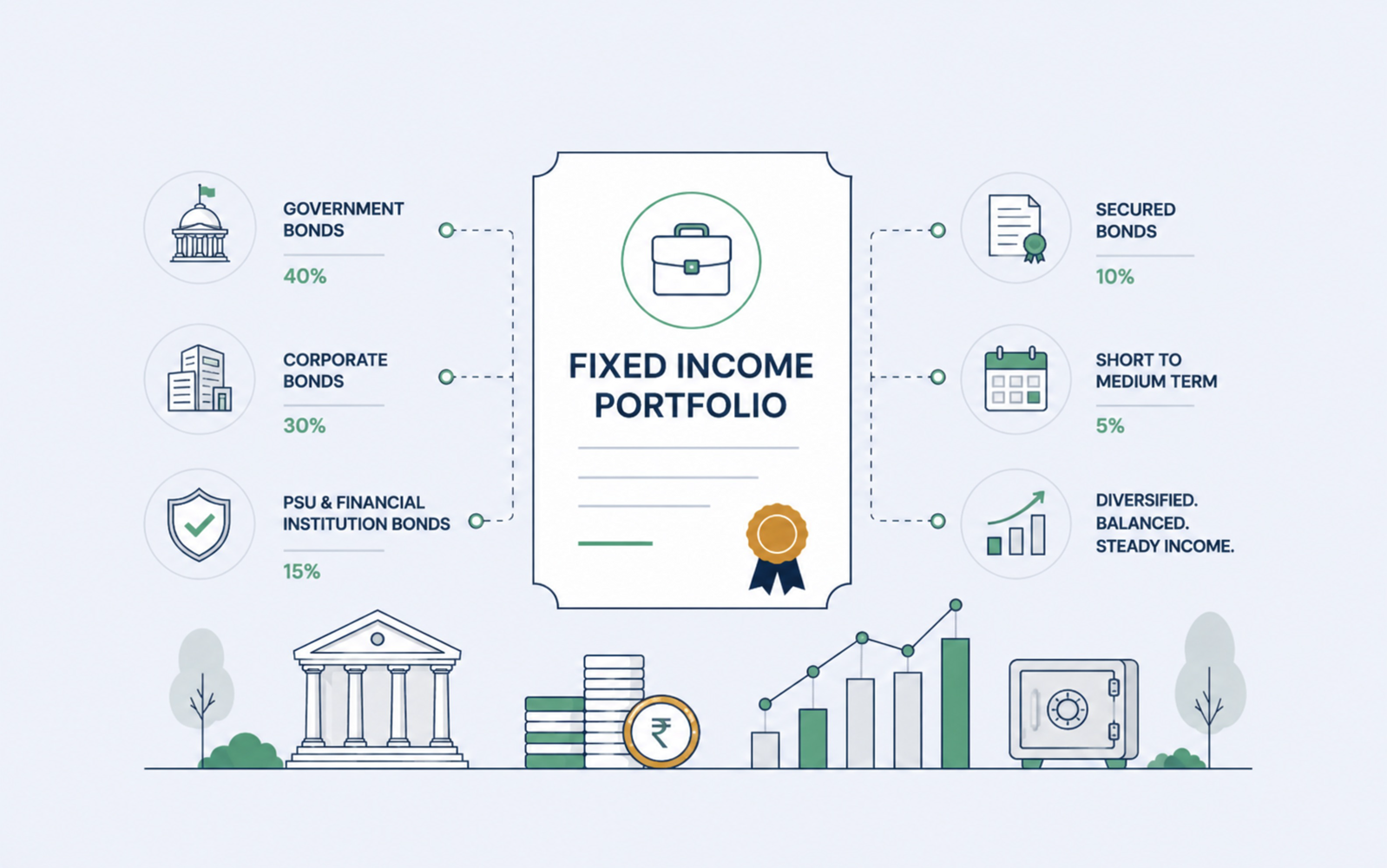
Core (~65%): a ladder of government securities and AAA/AA PSU and corporate bonds across 2–10 year maturities, providing liquidity, safety, and steady income. This is the ballast.
Satellites (~25%): a small set of researched, higher-yielding corporate bonds - each capped so no single issuer exceeds a few percent of the total - chosen when spreads are attractive and fundamentals check out. This lifts the blended yield.
Liquidity sleeve (~10%): highly liquid, short-dated government or top-rated instruments for near-term needs and to redeploy opportunistically when spreads widen.
Then the investor manages it dynamically: extending duration in the core when an easing cycle looks likely, trimming satellite credit exposure when spreads compress to complacent levels, and keeping the liquidity sleeve genuinely liquid at all times. The percentages aren’t the point - the logic is. Every rupee has a job, and every risk taken is a risk being paid for.
Common mistakes even sophisticated investors make
Chasing yield into compressed spreads. Adding credit risk when spreads are tight means taking the full downside for minimal reward. The comfort of a calm market is often when credit is worst-priced.
Confusing access with liquidity. Being able to buy a bond on a slick platform says nothing about your ability to sell it later at a fair price.
Over-diversifying into unmanageable sprawl. Owning fifty tiny positions you can’t monitor is not diversification - it’s neglect dressed up as prudence. Diversify enough to survive a default, not so much that you lose track of what you own.
Ignoring the tax drag differential. Two bonds with identical pre-tax yields can deliver materially different after-tax returns depending on listing status and holding period. Optimising pre-tax is optimising the wrong number.
Letting satellites quietly become the core. Positions drift. A high-yield satellite that performs well can grow into an outsized share of the portfolio, silently raising its risk. Rebalance deliberately.
Relying on ratings and ignoring spreads. Ratings lag reality; spreads lead it. An investor watching only ratings gets the news late.
What this means for you
A strong bond portfolio isn’t a pile of the highest-yielding bonds you could find. It’s a deliberate structure: a defensive, liquid core; carefully-sized satellites that take risk only where it’s well-paid; a duration profile that reflects your read of the cycle without betting everything on it; and an honest respect for liquidity and tax. Judge every holding by what it contributes to the whole - its after-tax return relative to the risk it adds, and whether that risk is one you’re genuinely being compensated for.
Do that consistently, and your fixed-income portfolio becomes what it’s supposed to be: the stable, income-generating foundation of your wealth - resilient enough to hold up when markets don’t, and thoughtful enough to earn a fair return while it does.
Key takeaways
Aim for after-tax return per unit of risk, not the highest yield. Anyone can raise yield by taking more risk; the skill is being paid fairly for it.
Credit spreads are your compensation for credit risk - add credit when spreads are wide and well-supported by fundamentals; reduce it when spreads are compressed.
Diversify across issuer, sector, rating, maturity, and instrument type, because a single default is asymmetrically damaging.
Choose a duration structure (ladder, bullet, or barbell) that fits your goals and macro view, within a core-satellite framework that contains risk.
Respect liquidity as a distinct risk - access is not liquidity - and judge every holding by its contribution to the resilience of the whole.
This is educational content, not personalized investment advice. Ratings can change, and a AAA rating does not eliminate credit risk; it only estimates it as lower.