
The threshold, the rate, and how to reconcile it at filing time.
Interest Rate Risk, Duration & Bond Laddering: Protecting Your Fixed Income
There’s a comforting myth that bonds are “safe” in a way that never wavers. Hold a healthy bond to maturity and yes, your outcome is predictable. But between today and maturity, the value of your bond can swing - sometimes sharply - and the main reason is something entirely outside the issuer’s control: the level of interest rates in the economy.
This article explains that risk, gives you a tool to measure it (duration), shows you a practical strategy to manage it (laddering), and closes with how the taxman treats your bond returns in India. Together, these turn “bonds are safe” from a vague belief into something you can actually control.
The risk that has nothing to do with default
Most people, when they think of bond risk, think of default - the issuer failing to pay. That’s real, and credit ratings help you judge it. But there’s a second, more constant risk that even a Government of India bond carries in full: interest rate risk.
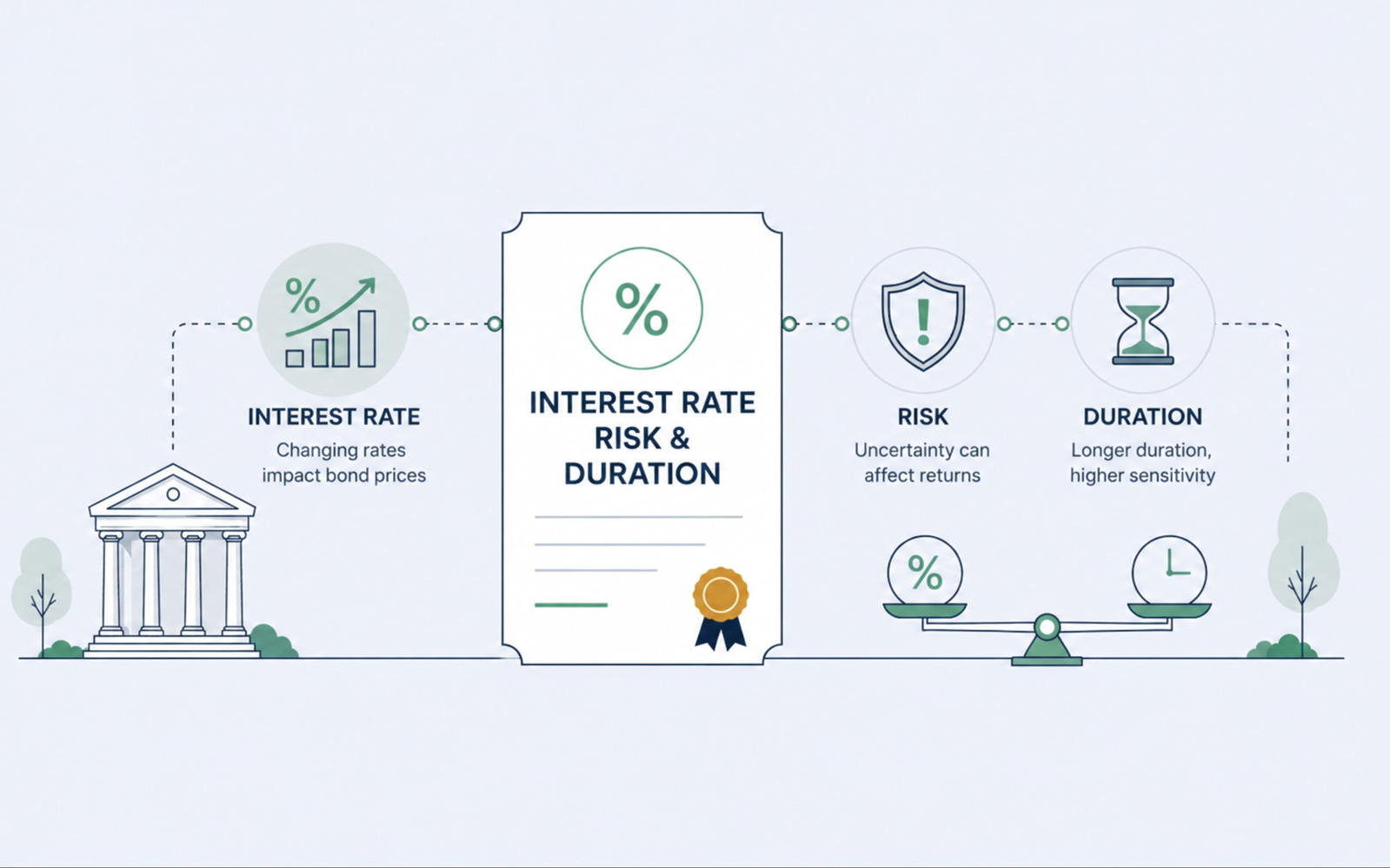
Recall the seesaw from the world of yields: when market interest rates rise, the prices of existing bonds fall, and vice versa. Interest rate risk is simply the danger that rates move against you while you’re holding a bond, changing its market value.
Here’s why it matters even if you never plan to sell. Suppose you lock into a 10-year bond at 7%, and a year later similar new bonds are paying 9%. You’re now stuck earning 7% for nine more years while everyone else earns 9%. Your money is trapped at a below-market rate - an opportunity cost that’s just as real as a price drop. Interest rate risk cuts both ways: as a price loss if you sell, or as a lost-opportunity if you hold.
The follow-up question is the useful one: how badly will a given bond be affected? Not all bonds react equally, and that’s where duration comes in.
Duration: measuring how sensitive your bond is
Duration is a number that tells you roughly how much a bond’s price will move for a 1% change in interest rates. It’s expressed in years, which confuses people, so let’s cut through it.
A practical way to read duration: a bond with a duration of 5 will fall about 5% in price if interest rates rise by 1%, and rise about 5% if rates fall by 1%. A bond with a duration of 2 will move only about 2% for the same 1% rate change. Higher duration means higher sensitivity - a bumpier ride when rates move.
So what makes one bond’s duration higher than another’s? Two main factors:
Time to maturity. The longer you have to wait for your money, the more a rate change affects the value of those distant payments. A 20-year bond has far higher duration than a 2-year bond. This is the dominant driver.
Coupon size. A bond that returns more of your money sooner (through larger coupons) has slightly lower duration than a low-coupon bond of the same maturity, because you’re getting cash back earlier.
You don’t need to compute duration yourself - bond platforms and fund fact sheets publish it. What you need is the instinct to use it: when you expect rates to rise, favour lower-duration (shorter) bonds to limit damage; when you expect rates to fall, higher-duration (longer) bonds will gain the most.
Here’s the relationship at a glance, using illustrative figures:
If rates rise by 1% | Approx. price change |
|---|---|
Duration 2 bond | −2% |
Duration 5 bond | −5% |
Duration 10 bond | −10% |
(Illustrative. The relationship is approximate and less precise for large rate moves, but the ranking always holds: longer duration, bigger swings.)
The honest catch is that predicting rate moves is genuinely hard - even central banks get surprised. Which is exactly why the smartest approach for most investors isn’t to bet on the direction of rates at all. It’s to build a structure that works reasonably well whatever rates do. That structure is called a ladder.
Bond laddering: a strategy that doesn’t require a crystal ball
A bond ladder is a portfolio of bonds with staggered maturity dates. Instead of putting all your money into one bond maturing in, say, 2035, you spread it across several bonds maturing in 2027, 2029, 2031, 2033, and 2035 - each “rung” of the ladder maturing at a different time.
Why bother? Because it quietly solves the rate-prediction problem.
Think of it like a farmer who doesn’t plant the entire field on one day. By staggering the planting, some crop is always coming in, and no single bad week ruins the whole harvest. A bond ladder does the same with your money: something is always maturing, freeing up cash you can either spend or reinvest at whatever rates prevail then.
When rates rise, you’re glad - because each maturing rung returns cash you reinvest into new, higher-yielding bonds. The pain of rate rises is softened by the reinvestment opportunity.
When rates fall, you’re partly protected too - because most of your money is still locked into the older, higher-yielding bonds you bought earlier. Only the maturing rung has to be reinvested at the new, lower rate.
Either way, you avoid the two worst outcomes: dumping everything into long bonds right before rates rise, or being forced to reinvest your entire portfolio at a bad moment. A ladder trades away the chance of a perfectly-timed jackpot in exchange for steadiness - a trade most income investors are happy to make.
A simple illustrative ladder
Imagine you have ₹5 lakh to invest. Rather than one bond, you build five rungs:
Rung | Amount | Maturity | Role |
|---|---|---|---|
1 | ₹1,00,000 | ~2 years | Near-term liquidity |
2 | ₹1,00,000 | ~4 years | Reinvestment window |
3 | ₹1,00,000 | ~6 years | Medium-term yield |
4 | ₹1,00,000 | ~8 years | Higher yield |
5 | ₹1,00,000 | ~10 years | Longest yield lock-in |
As rung 1 matures, you either take the cash or roll it into a new 10-year bond, which becomes your new longest rung. The ladder keeps rolling forward indefinitely. It’s simple, mechanical, and it removes the pressure to guess the market - which is precisely its strength.
The taxation you can’t ignore
A return you can’t keep isn’t really your return. In India, bond income is taxed in two distinct ways, and the rules changed meaningfully in recent years, so it’s worth being precise. The following reflects the framework in force as of 2026; tax law changes, and your own situation can differ, so treat this as orientation and confirm specifics with a qualified tax advisor.
1. Interest income (your coupons). The regular coupon payments you receive are added to your total income and taxed at your applicable income tax slab rate. There’s no special concession for most bonds here - coupon income is treated much like FD interest. (A small category of older tax-free bonds, issued by certain government-backed entities, pay interest that is exempt, but no new ones are being issued.)
2. Capital gains (profit from selling before maturity). If you sell a bond in the secondary market for more than you paid, the profit is a capital gain, taxed based on how long you held it and whether the bond is listed:
Listed bonds held for 12 months or less: the gain is a short-term capital gain, taxed at your slab rate.
Listed bonds held for more than 12 months: the gain is a long-term capital gain, taxed at a flat 12.5%, without indexation (for transfers made on or after 23 July 2024).
Unlisted bonds and debentures: under current rules (Section 50AA), gains are treated as short-term and taxed at your slab rate regardless of how long you held them - an important change that removed the earlier long-term concession for these instruments.
The removal of indexation across bond categories means you can no longer inflate your purchase cost to reduce taxable gains, which matters more the longer you hold and the higher inflation runs.
What this means in practice:
For a high-income investor, the flat 12.5% long-term rate on listed bonds can be gentler than paying slab rate (which reaches 30%-plus with surcharge and cess) on coupon income. That can make listed bonds bought below face value, where part of your return comes as a maturity gain, comparatively tax-efficient.
For someone in a lower slab, coupon income may be taxed lightly or not at all after rebates, so the structure that’s most efficient depends on your own tax position.
The listed-versus-unlisted distinction genuinely affects your after-tax return. All else equal, the tax treatment of listed bonds is now more favourable for long-term holders than that of unlisted ones.
There’s also TDS to be aware of - tax deducted at source on certain bond interest - which is an advance against your final liability, not an extra tax, and can be adjusted when you file your return.
The broader lesson: always evaluate bonds on their after-tax yield, not the headline YTM. Two bonds with identical yields can leave very different amounts in your pocket once tax is applied.
Common mistakes to avoid
Buying long-duration bonds without meaning to. Chasing the slightly higher yield of a 15-year bond can quietly load you with duration risk you didn’t sign up for. Check the duration before you buy.
Putting everything in one maturity. It concentrates both your reinvestment timing and your rate risk at a single point. Ladder instead.
Assuming “hold to maturity” makes rate risk disappear. It removes the price risk but not the opportunity cost of being locked at a below-market rate.
Comparing pre-tax yields across differently-taxed bonds. A listed and an unlisted bond with the same YTM are not equal after tax.
Reinvesting the entire ladder in one go out of impatience. The whole point of a ladder is staggering - collapsing it defeats the purpose.
What this means for you
Interest rate risk is the price of admission for owning bonds, and it never fully goes away - but you’re not helpless against it. Use duration to know how exposed each bond makes you. Use a ladder to stop needing to predict rates in the first place. And always run your returns through the tax filter before deciding, because the number that matters is what reaches your bank account after the government takes its share.
Done together, these three habits turn bond investing from something that happens to you into something you actively manage.
Key takeaways
Interest rate risk affects every bond, including government bonds - when rates rise, existing bond prices fall.
Duration measures sensitivity: a duration-5 bond moves about 5% for a 1% rate change. Longer maturity means higher duration and bigger swings.
Bond laddering - staggering maturities - lets you manage rate risk without predicting rates, keeping money regularly free to reinvest.
In India, coupon interest is taxed at your slab rate, while capital gains depend on holding period and listing status (listed long-term gains at a flat 12.5%; unlisted gains treated as short-term).
Judge bonds by their after-tax return, not the headline yield, and confirm current tax rules with a professional.
This is educational content, not personalized investment advice. Ratings can change, and a AAA rating does not eliminate credit risk; it only estimates it as lower.