
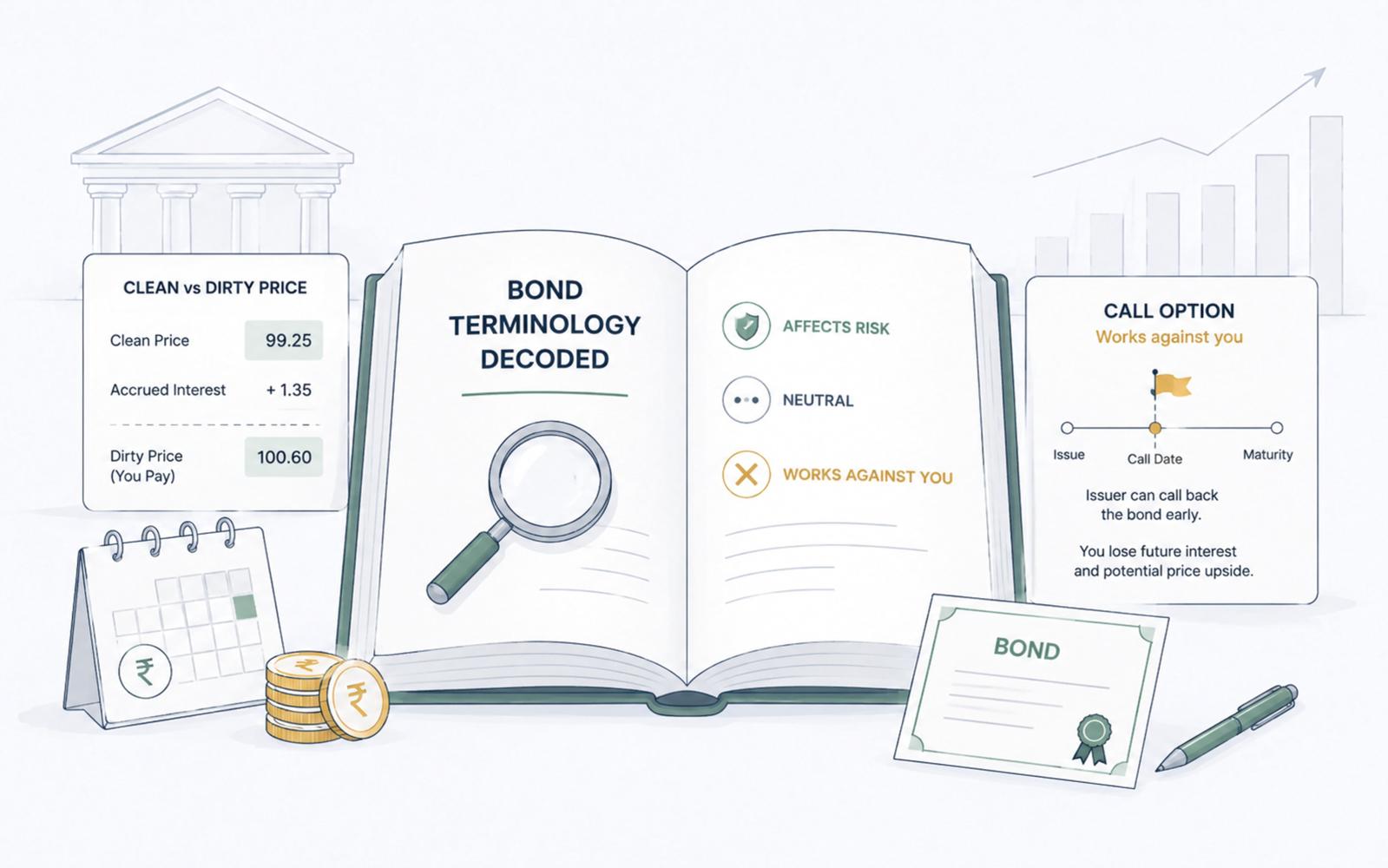
A glossary that sorts terms by whether they actually change your risk. Explains why the debited amount exceeds the quoted price (clean vs dirty price) and why a call option structurally works against you.
Open any bond listing for the first time and you’re met with a wall of terms: ISIN, coupon frequency, put option, seniority, record date, accrued interest. It reads like a form written for someone else. Most people either skip the details or, worse, buy without understanding them.
The good news is that the vocabulary is small and the logic behind it is consistent. This article walks through the terms you’ll actually meet, explains what each one does, and - importantly - flags which ones change your risk and which are merely administrative.
Start with the identity of the bond
ISIN
Every bond has an ISIN (International Securities Identification Number), a unique 12-character code. Think of it as the bond’s Aadhaar number. Two bonds from the same company can have entirely different terms, so the company name alone doesn’t identify what you’re buying - the ISIN does. When you compare bonds across platforms or check a bond’s details, the ISIN is the reliable identifier.
Issuer
The entity borrowing your money. This determines your credit risk, and it’s the single most consequential item in the listing. “Issued by a subsidiary of a large group” is not the same as “issued by the parent” - read carefully, because the entity named is the one that owes you.
NCD
You’ll frequently see NCD, meaning Non-Convertible Debenture. A debenture is a bond, and “non-convertible” means it stays a loan - it can’t be converted into shares of the company. Most corporate bonds available to retail investors in India are NCDs. The term sounds exotic; the instrument is ordinary.
The money terms
Face value (or par value)
The amount the issuer repays per unit at maturity, and the base on which the coupon is calculated. Many listed bonds in India now carry a face value of ₹10,000, following regulatory changes designed to widen retail access.
Coupon and coupon frequency
The coupon is the annual interest rate on the face value. Frequency tells you how it’s split - annual, semi-annual, quarterly, or monthly.
Frequency doesn’t change your headline rate much, but it matters practically in two ways. If you need regular income, monthly or quarterly payments smooth your cash flow. And more frequent payments return money to you sooner, which you can reinvest - a small but genuine advantage.
Some bonds are cumulative, meaning they pay no periodic interest and instead accumulate it, paying everything at maturity. Useful for growing a lump sum; useless if you need income along the way.
Maturity date
When the issuer repays your face value and the arrangement ends. Longer maturities generally offer higher yields but expose you to more price movement if you sell early.
Yield / YTM
The yield to maturity is your actual annualised return if you buy at today’s price and hold to maturity. This is the number to compare bonds on - not the coupon. If you take one habit from bond investing, make it this one.
The terms that change your risk
This is the section most beginners skip and shouldn’t. These items materially change what you own.
Secured vs unsecured
A secured bond is backed by specific assets of the issuer. If the company fails, those assets can be sold to repay you. An unsecured bond has no such backing - you’re relying purely on the company’s ability to pay.
Secured bonds are generally safer and, for that reason, usually pay a bit less. Two bonds from the same issuer can differ on this alone, which is exactly why the ISIN matters more than the company name.
Seniority
If an issuer fails, its various lenders are repaid in a defined order. Senior bondholders are paid before subordinated ones. Subordinated bonds pay more precisely because they’re further back in the queue - and in a genuine default, “further back in the queue” often means recovering considerably less.
A useful mental image: seniority is your position in a line at a counter that may run out of money before it reaches the end. Being paid extra to stand further back is only worth it if you understand the risk of the line running dry.
Call option (callable bonds)
A call option gives the issuer the right to repay the bond early, on specified dates. This exists for the issuer’s benefit, not yours.
Consider why. If interest rates fall, the issuer would rather cancel your expensive 9% bond and reissue at 7%. So they call it. You get your principal back - at exactly the moment when reinvesting is least attractive, because rates have dropped. The call option effectively caps your upside while leaving your downside intact.
This is worth stating plainly: a callable bond is structurally less favourable to you than an identical non-callable one. If it doesn’t pay a higher yield to compensate, it isn’t pricing the option properly.
Put option (puttable bonds)
The mirror image, and this one favours you. A put option gives the investor the right to sell the bond back to the issuer on specified dates. It’s a valuable escape hatch if rates rise or the issuer’s health deteriorates. Puttable bonds typically yield slightly less, because you’re being given something worth having.
Credit rating
A grade assigned by agencies like CRISIL, ICRA, CARE, or India Ratings, signalling the likelihood of timely repayment. AAA is the highest; ratings descend through AA, A, BBB and below. A rating is an informed opinion about the future, not a guarantee, and it can change while you hold the bond.
The administrative terms
These don’t change your risk, but misunderstanding them causes confusion and the occasional unpleasant surprise.
Accrued interest and the “dirty price”
Here’s the one that catches almost everyone. You see a bond quoted at ₹1,020 but ₹1,042 is debited from your account. Nothing has gone wrong.
When you buy a bond between coupon dates, the seller has already earned interest for the days they held it - even though the coupon hasn’t been paid yet. That earned-but-unpaid amount is accrued interest, and you compensate the seller for it at purchase. You get it back at the next coupon payment, when you receive the full coupon despite having held the bond for only part of the period.
The terms for this: - Clean price - the quoted price, excluding accrued interest. Used for comparison. - Dirty price - the clean price plus accrued interest. This is what actually leaves your bank account.
Illustrative example: a ₹1,000 face value bond with a 9% annual coupon (₹90 a year), bought three months after the last coupon date. Accrued interest is roughly ₹90 × (3 ÷ 12) = ₹22.50. If the clean price is ₹980, you pay about ₹1,002.50. You haven’t lost ₹22.50 - you’ve prepaid it and will recover it at the next coupon.
Conventions differ by market segment: government securities are typically quoted clean with accrued interest added separately, while corporate bonds on the exchanges are commonly settled at the dirty price. Either way, the underlying logic is the same.
Record date
The cut-off date for determining who receives the upcoming coupon. If you own the bond on the record date, the coupon comes to you. Buy after it, and the previous holder receives that payment.
Day count convention
The formula for counting days when calculating accrued interest (for example, treating each month as 30 days versus using actual days). It causes tiny differences in amounts and matters far more to institutions than to individual investors. Worth recognising; not worth losing sleep over.
A quick reference table
Term | What it means | Does it change your risk? |
|---|---|---|
ISIN | Unique bond identifier | No - but essential for identifying the right bond |
Face value | Amount repaid at maturity per unit | No |
Coupon | Annual interest rate on face value | No |
YTM | Your real return at current price | No - but it’s how you compare |
Secured / unsecured | Whether assets back the bond | Yes |
Seniority | Your place in the repayment queue | Yes |
Call option | Issuer can repay early | Yes - works against you |
Put option | You can exit early | Yes - works in your favour |
Credit rating | Opinion on repayment likelihood | Yes |
Accrued interest | Interest owed to the seller | No |
Record date | Who gets the next coupon | No |
Reading a listing in practice
Faced with a bond listing, work through it in this order:
Who is the issuer, exactly? Note the precise entity, not the brand.
What’s the credit rating? Establishes your baseline risk.
Is it secured or unsecured, senior or subordinated? These decide what you’d recover if things go wrong.
Is there a call option? If yes, your upside is capped - check you’re paid for it.
What’s the YTM, not the coupon? This is your actual expected return.
When does it mature, and can I hold that long? Match it to your horizon.
What will actually be debited? Expect the dirty price, including accrued interest.
Seven questions. Answer them and you understand the bond better than most people who buy one.
Common mistakes
Comparing bonds by company name. The same issuer can have multiple bonds with different security, seniority, and call features. The ISIN identifies what you’re buying.
Overlooking a call option. Discovering your high-yield bond can be repaid early, right when rates have fallen, is an avoidable surprise.
Panicking about the dirty price. The extra debit is prepaid interest you’ll recover, not a hidden charge.
Treating “secured” as “guaranteed.” Security improves your recovery prospects; it doesn’t eliminate the possibility of loss.
Reading the coupon as the return. The coupon is the promise on face value; YTM is your return at the price you pay.
What this means for you
Bond jargon isn’t there to intimidate you - most of it is descriptive, and once you know what each term does, a listing becomes readable in under a minute. Focus your attention where it counts: the issuer, the rating, the security and seniority, and whether the issuer can call the bond away from you. Those four items shape your risk. The rest is mostly plumbing.
Key takeaways
The ISIN identifies a specific bond; the same issuer can have bonds with very different terms.
YTM, not the coupon, is the number to compare bonds on.
Four terms genuinely change your risk: secured vs unsecured, seniority, call options, and credit rating.
A call option favours the issuer and should come with extra yield; a put option favours you.
The higher amount debited at purchase is accrued interest (the dirty price) - prepaid, not lost.
This is educational content, not personalized investment advice. Ratings can change, and a AAA rating does not eliminate credit risk; it only estimates it as lower.