
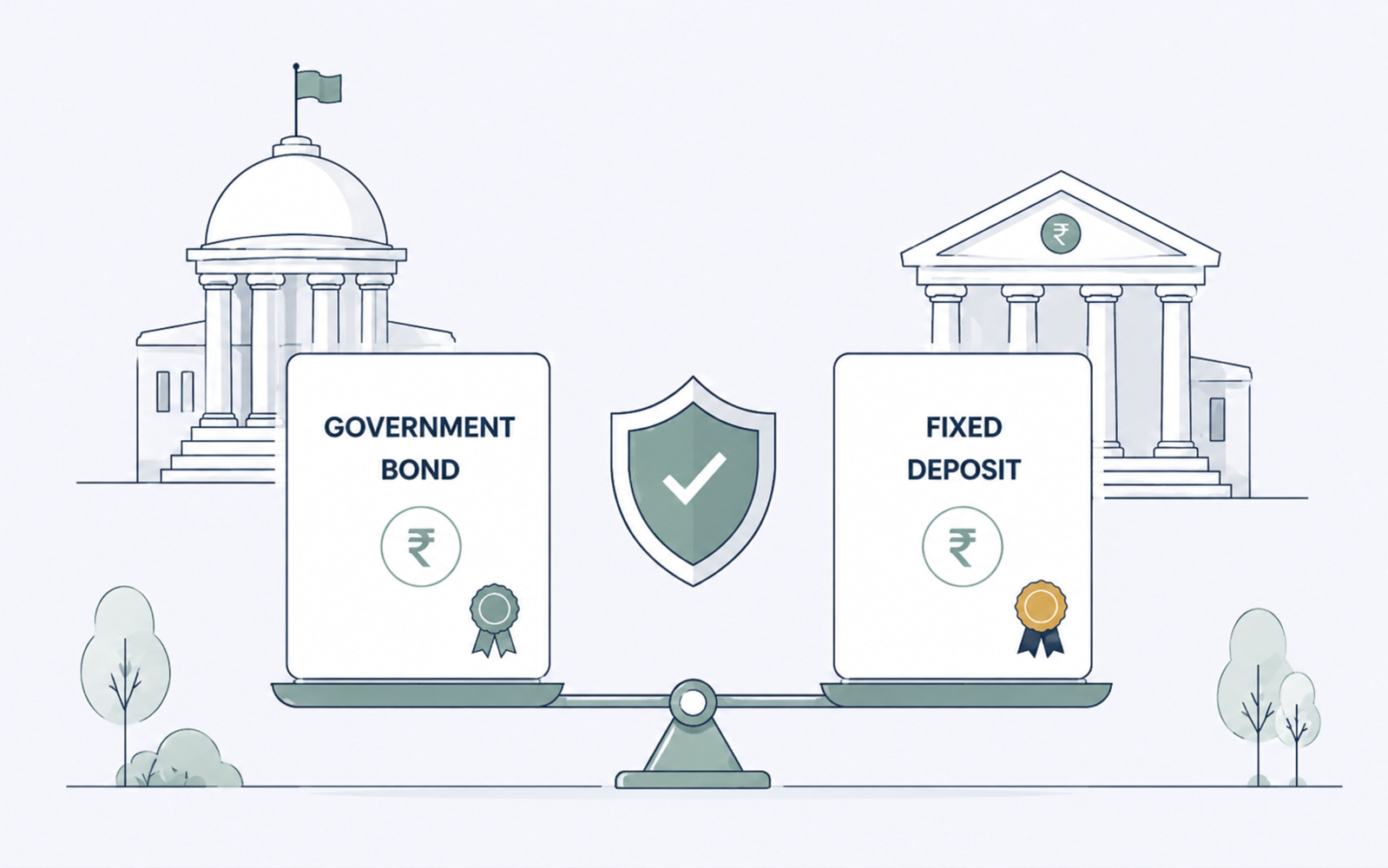
The highest-intent comparison in Indian personal finance. Built around a counterintuitive point most FD content misses: DICGC insurance is a ₹5 lakh cap, so for large balances a G-Sec can genuinely be the safer home than a bank deposit.
The fixed deposit is the default setting of Indian saving. It’s what our parents used, what banks push at every branch visit, and what most of us open without a second thought. There’s nothing wrong with that - the FD is a genuinely good product for certain jobs.
But “good for certain jobs” is different from “good for everything.” A lot of money sits in fixed deposits not because it’s the right place for it, but because nobody ever presented the alternative clearly. This article does that, without pretending bonds are superior in every way. They aren’t.
The same idea, different counterparty
Strip away the packaging and an FD and a bond are close cousins. In both, you hand over money, receive interest for an agreed period, and get your principal back at the end.
The differences come down to four practical things: who owes you the money, what happens if you need it back early, how much you earn, and how you’re taxed. Let’s take them one at a time.
Difference 1: Who owes you the money
With an FD, your borrower is a bank. That’s it - one counterparty, chosen mostly by where you already have an account.
With bonds, you choose your borrower from a much wider field: the Government of India, a state government, a public sector company like a power or railway financier, or a private corporation. This is the most underappreciated advantage of bonds. You can actually lend to a safer borrower than your bank.
That sounds surprising, so sit with it for a moment. A bank is a business. A well-run one is very safe, but it is still a commercial enterprise that can fail - and Indian banking history has a handful of examples where depositors faced anxious months. The Government of India, which prints the rupee and collects the taxes, sits above any bank in the safety hierarchy for rupee obligations.
The deposit insurance nuance. Bank deposits in India are insured by the DICGC up to ₹5 lakh per depositor per bank, covering principal and interest together. This is a real and valuable protection - and it’s the single strongest argument for FDs. But notice its shape: it’s a cap. If you have ₹40 lakh in fixed deposits at one bank, the vast majority of that money is not insured; you’re relying on the bank’s health, not on the guarantee.
This leads to a conclusion many savers find counterintuitive: for small amounts, an FD’s insurance makes it extremely safe. For large amounts at a single bank, a government security may actually be the safer home.
Difference 2: Getting your money back early
Break an FD before maturity and you’ll typically face a penalty - usually a reduction in the interest rate you earn, so you receive less than promised. The mechanism is simple and predictable. Importantly, you don’t lose principal; you just earn less.
Bonds work differently. Many listed bonds can be sold in the secondary market to another investor. There’s no “penalty” as such - but the price you receive is whatever the market will pay that day, which could be more or less than you paid. If interest rates have fallen since you bought, you might sell at a profit. If rates have risen, you might take a loss.
There’s a second, blunter issue: not all bonds are easy to sell. Government securities and large, highly-rated bonds usually find buyers readily. Smaller or lower-rated corporate bonds can trade thinly, meaning you might struggle to sell at a fair price at all. An FD, whatever its penalty, can always be broken. A thinly-traded bond cannot always be sold.
So the honest scorecard: bonds offer more upside on early exit and more uncertainty. FDs offer predictable, modest cost on early exit and certainty.
Difference 3: What you earn
Here’s where bonds usually pull ahead, and here’s why it isn’t magic.
An FD rate is set by one bank, competing with other banks, and constrained by regulation and its own funding needs. Bond yields are set by a market pricing thousands of borrowers of varying quality. That wider market naturally produces a wider range of returns - including options that pay more than a comparable FD.
The reason a corporate bond pays more than an FD is not that you’ve found a loophole. It’s that you’ve accepted a different risk: the risk of that specific company, without deposit insurance. Sometimes that’s a sensible trade - a top-rated public sector financier is a robust borrower - and sometimes it isn’t.
The rule to carry with you: any bond yielding dramatically more than an FD is not a better version of an FD. It’s a different, riskier product wearing similar clothes. Understanding what you’re being paid for is the entire skill.
Difference 4: Tax treatment
This is where bonds have a specific, structural edge that many savers never discover, so it’s worth explaining plainly.
FD interest is added to your income and taxed at your slab rate. If you’re in the 30% bracket, roughly a third of your interest goes to tax. There’s no alternative treatment available.
Bond returns can come in two forms, taxed differently:
Coupon interest is taxed at your slab rate - same as FD interest, no advantage.
Capital gains, if you buy a listed bond below face value and sell or hold it to maturity at a higher value, are taxed differently. For listed bonds held more than 12 months, long-term capital gains are taxed at a flat 12.5% without indexation (for transfers on or after 23 July 2024).
Why does this matter? Because for someone in the highest tax bracket, a flat 12.5% is meaningfully lighter than a 30%-plus slab rate. A listed bond bought at a discount, where part of your return arrives as a capital gain rather than as interest, can therefore leave more in your pocket than an FD offering the same headline rate.
Two important caveats. First, this advantage applies to listed bonds; gains on unlisted bonds and debentures are currently treated as short-term and taxed at slab rate regardless of holding period. Second, if you’re in a low tax bracket where rebates already reduce your liability to near zero, this advantage largely disappears - slab-rate income may actually be more efficient for you. Tax rules also change with each Budget, so confirm current provisions with a qualified advisor.
Side by side
Factor | Fixed Deposit | Bonds |
|---|---|---|
Borrower | Your bank | Government, PSU, or company - you choose |
Safety net | DICGC insurance up to ₹5 lakh per bank | None; depends on issuer quality |
Early exit | Break with an interest penalty; always possible | Sell in the market; price uncertain, liquidity varies |
Return range | Narrow, set by the bank | Wider, set by the market and issuer risk |
Interest tax | Slab rate | Slab rate on coupons |
Capital gains tax | Not applicable | Listed bonds: flat 12.5% long-term (over 12 months) |
Effort required | Minimal | Some research and a demat account |
Where each one genuinely wins
Rather than declaring a winner, match the tool to the task.
Choose a fixed deposit when: - The amount is within the ₹5 lakh insurance limit and you want maximum simplicity. - You might need the money at short notice and want certainty about getting it. - You’re building an emergency fund, where predictability matters more than return. - You simply don’t want to research anything, and that’s a legitimate preference.
Consider bonds when: - You’re holding amounts well above the insurance limit at one bank, and want a genuinely safer borrower (government securities). - You’re in a higher tax bracket and the capital gains treatment on listed bonds could improve your after-tax return. - You want to earn more than FD rates and understand you’re taking issuer risk to do it. - You want predictable income across a longer horizon than banks typically offer at attractive rates.
Most sensible savers don’t pick one exclusively. A practical pattern looks like: emergency money and short-term needs in FDs and savings, and longer-term money spread across government securities and quality bonds - sized so that no single issuer, bank included, holds too much of your wealth.
Common mistakes
Assuming a bond is just a higher-paying FD. It isn’t. There’s no deposit insurance, and issuer quality varies enormously.
Keeping ₹50 lakh in one bank’s FDs and calling it safe. Only ₹5 lakh of that is insured. Concentration risk is real even in “safe” products.
Chasing the highest bond yield to beat FD rates. The extra yield is compensation for extra risk, not a reward for being clever.
Ignoring liquidity. Money you may need next month has no business in a thinly-traded bond, whatever its yield.
Comparing pre-tax rates. An 8% bond and an 8% FD can deliver quite different amounts after tax, depending on your bracket and the return’s structure.
What this means for you
Fixed deposits are not a mistake, and bonds are not an upgrade. They’re different instruments with different strengths. The FD gives you insurance, simplicity, and certainty of access. Bonds give you a choice of borrower, a wider range of returns, and - for higher-bracket investors holding listed bonds - a potential tax advantage.
The practical question isn’t “which is better?” It’s “which job am I hiring this money to do?” Answer that, and the choice usually makes itself.
Frequently asked questions
1. Are bonds safer than fixed deposits? It depends entirely on the bond. Government securities are generally considered safer than a bank deposit above the insurance limit, since the sovereign sits above any bank. But a low-rated corporate bond is riskier than an insured FD. The category doesn’t decide safety - the issuer does.
2. Do bonds always pay more than FDs? No. Government securities can yield less than a bank FD, because they carry less risk. Corporate bonds usually pay more, precisely because they carry more risk.
3. What is the ₹5 lakh deposit insurance limit? Bank deposits in India are insured by the DICGC up to ₹5 lakh per depositor per bank, covering principal and interest combined. Amounts above that at the same bank are not covered by the guarantee.
4. Can I lose money in bonds the way I can’t in an FD? Yes, in two ways an FD doesn’t expose you to: the issuer could default, or you could sell before maturity at a lower price than you paid. Holding a sound bond to maturity avoids the second risk.
5. Are bonds more tax-efficient than FDs? They can be, for higher-bracket investors. FD interest is always taxed at your slab rate; long-term gains on listed bonds are taxed at a flat 12.5%. For lower-bracket investors, the advantage may not apply.
6. Should I move all my FD money into bonds? Very unlikely to be wise. Emergency funds and short-horizon money benefit from the FD’s certainty and easy access. Bonds suit longer-term money and larger amounts where issuer choice and tax treatment matter.
Key takeaways
An FD and a bond are structurally similar - the differences lie in who owes you, early-exit terms, return range, and tax.
DICGC insurance covers ₹5 lakh per depositor per bank, which makes small FDs very safe but leaves large balances exposed.
Bonds let you choose your borrower, including the sovereign, which can be safer than a bank for large sums.
Bonds can be more tax-efficient for higher-bracket investors, since long-term gains on listed bonds are taxed at a flat 12.5% rather than slab rate.
Neither is universally better. Match the instrument to the job - emergency money in FDs, longer-term money across quality bonds.
This is educational content, not personalized investment advice. Ratings can change, and a AAA rating does not eliminate credit risk; it only estimates it as lower.