
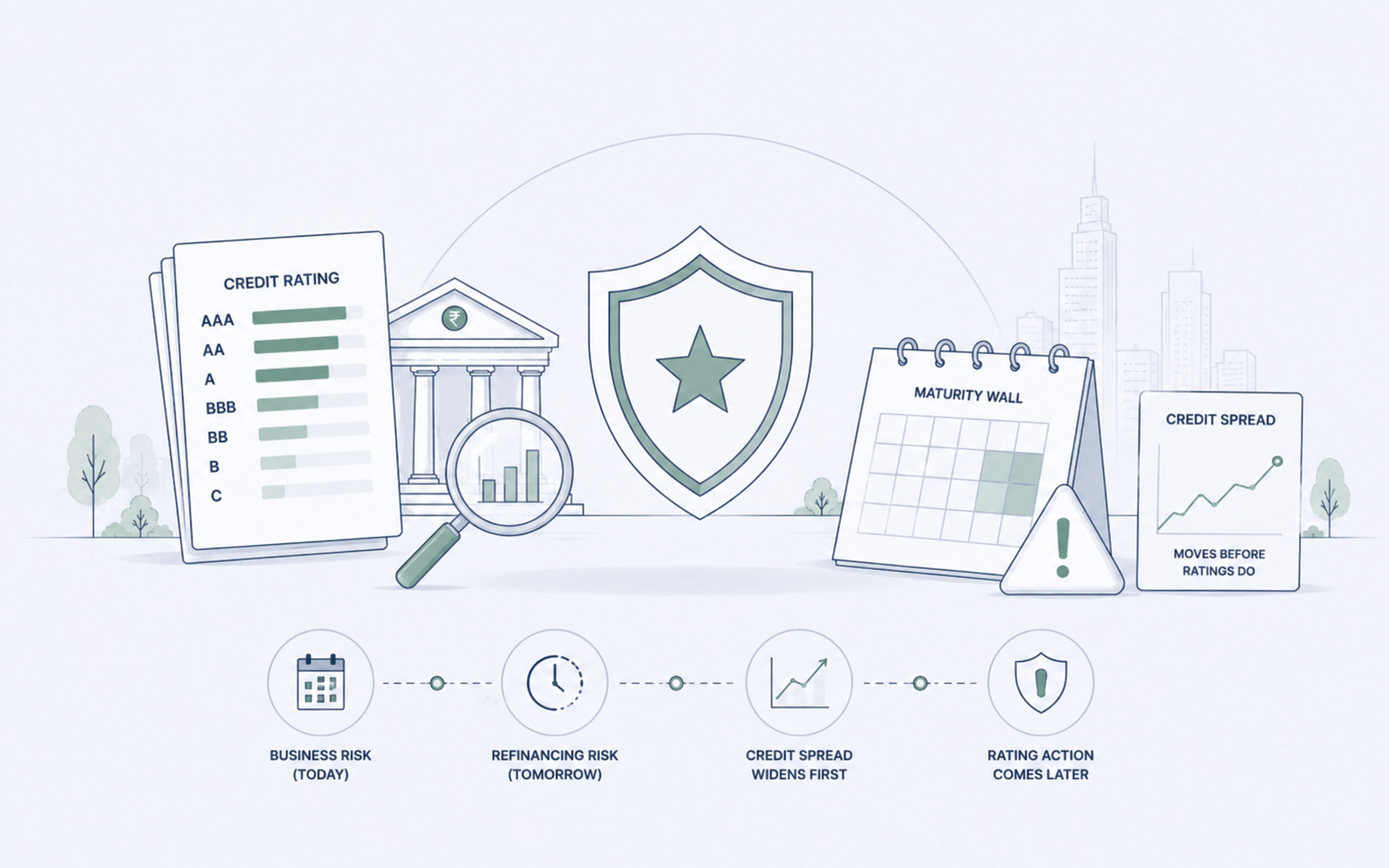
How ratings work, what they miss, and why credit spreads move before ratings do. Emphasises refinancing risk, since many Indian credit accidents were maturity-wall failures rather than business failures.
Credit ratings are the most-used and least-understood tool in bond investing. Most investors treat them as a verdict: AAA means safe, buy it; anything lower means risky, avoid it. That reading is too crude to be useful, and occasionally it’s dangerous.
A rating is a professional opinion about the probability of timely repayment, produced under specific assumptions, at a specific point in time. Learn what it does and doesn’t capture, and you’ll make sharper decisions than an investor who simply scans for the letter A.
What a rating actually claims
In India, credit ratings are issued by SEBI-registered agencies including CRISIL, ICRA, CARE, and India Ratings. Their scales follow a broadly similar structure:
Band | Broad meaning | Category |
|---|---|---|
AAA | Highest degree of safety | Investment grade |
AA | High degree of safety | Investment grade |
A | Adequate degree of safety | Investment grade |
BBB | Moderate degree of safety | Investment grade (lowest rung) |
BB | Moderate risk of default | Sub-investment grade |
B / C | High to very high risk | Sub-investment grade |
D | In default | Default |
Agencies add “+” and “−” modifiers within bands to indicate relative standing. The critical dividing line is between BBB and BB - the boundary of investment grade. Many institutional investors are mandated to hold only investment-grade paper, which is why a downgrade across that line can trigger forced selling and a sharp price fall, independent of the issuer’s actual condition.
Three things a rating specifically claims:
It’s an opinion on the likelihood of timely payment of interest and principal.
It’s relative, not absolute - a ranking against other issuers, not a precise probability.
It applies to a specific instrument, not the whole company. The same issuer’s secured senior bond and subordinated bond can carry different ratings, which is why the ISIN matters more than the company name.
What a rating does not tell you
This is where most investors go wrong, and each item below has cost real money.
It doesn’t tell you about price risk. A AAA-rated bond can lose value if interest rates rise. The rating addresses default probability, not market price. A “safe” bond can still show a loss if you sell it early.
It doesn’t tell you about liquidity. A well-rated bond from a small issue can be hard to sell. Ratings say nothing about whether a buyer will exist when you want out.
It doesn’t tell you about recovery. Two bonds could carry similar ratings but differ enormously in what you’d recover after a default, depending on security and seniority. Some agencies publish separate recovery assessments, but the headline rating isn’t one.
It isn’t a fixed property. Ratings migrate. A bond bought at AA can be A within a year. And downgrades have an uncomfortable habit of arriving in clusters and moving faster than upgrades - a company under stress can fall several notches in a short period, because deterioration feeds on itself as funding costs rise.
It’s backward-looking at the margins. Agencies work from reported financials and disclosed information. When a company’s problems stem from something not yet visible in its statements - undisclosed related-party exposure, aggressive accounting, or a sudden loss of market confidence - ratings can lag events. Indian debt markets have seen episodes where highly-rated issuers were downgraded steeply within weeks, catching investors who relied on the letter alone.
That last point is the one to internalise: a rating is a considered opinion, not a warranty, and its update speed is limited by the information the agency has.
The signal that often moves first
If ratings lag, what leads?
Credit spreads. The extra yield a bond trades at over a comparable government bond reflects the market’s live, continuously-updated view of risk. When traders grow nervous about an issuer, they demand more yield - and the spread widens - often well before an agency formally acts.
The practical technique: watch whether a bond you hold is trading at a materially wider spread than similarly-rated peers. If the market is pricing your AA bond like an A bond, the market is telling you something the rating hasn’t caught up with yet. That’s a prompt to investigate, not to panic - the market is sometimes wrong - but it’s a far earlier signal than waiting for a downgrade notice.
A related tell is the rating outlook. Agencies attach a Positive, Stable, or Negative outlook, and place issuers on “watch” when a change is being considered. A Negative outlook is a genuine forward signal that many investors skim past while fixating on the letter.
Doing your own homework
You don’t need to replicate an agency’s process, but a few independent checks materially improve your judgement. These are questions, not formulas.
1. Does the business generate reliable cash? Debt is repaid from cash flow, not from profits on paper. Look for whether operating cash flow is consistent and positive across several years, including a bad one. A company with volatile or negative operating cash flow servicing large debt deserves scepticism regardless of its rating.
2. How much debt is there relative to earnings? Broad leverage measures - debt against operating earnings, or interest costs against operating profit - give a sense of the cushion. The specific ratio matters less than the direction: rising leverage over successive years is a warning even from a comfortable starting point.
3. When does the debt come due? This is the most underrated check. A company with sound fundamentals can still fail if a large amount of debt matures at a moment when refinancing markets are shut. Look at the maturity profile: is repayment spread out, or is there a wall of debt due at once? Many Indian credit accidents have been refinancing failures rather than business failures - the underlying company was viable, but it couldn’t roll over its borrowings in time.
4. Who owns and controls the issuer? Group structure matters. Is this entity a standalone business or dependent on a parent? Does the parent have a track record of supporting subsidiaries under stress? Governance quality - board independence, auditor changes, promoter pledging of shares - is a legitimate credit input, and abrupt auditor resignations have preceded more than one credit event.
5. How cyclical is the sector? A steady, regulated utility and a commodity producer with the same rating carry different real-world risk profiles across a cycle. Ratings attempt to account for this, but knowing your sector’s sensitivity helps you size positions sensibly.
6. Is the yield consistent with the rating? If a bond rated AA yields far more than its AA peers, one of two things is true: the market disagrees with the rating, or there’s a feature you’ve missed - a call option, subordination, or weak liquidity. Unexplained extra yield is always worth explaining before you buy.
A short case study in reasoning
An illustrative scenario, to show the checks working together. Suppose you’re considering two bonds, both rated AA, both maturing in four years, both from finance companies.
Bond A yields 8.4%. Bond B yields 9.6%.
The instinctive read is that Bond B is the better deal - same rating, more yield. The analytical read asks why the gap exists:
Is Bond B subordinated while Bond A is senior secured? That alone could explain it, and it means very different recovery prospects.
Is Bond B callable? You may be paid extra for giving the issuer an option against you.
Is Bond B’s issuer facing a concentrated block of maturing debt next year, with the market pricing refinancing risk the rating hasn’t yet reflected?
Is Bond B simply less liquid, so buyers demand a premium for the difficulty of exiting?
Or has Bond B’s issuer been placed on Negative outlook?
Any one of these could be the answer, and each has a different implication. If it turns out Bond B is senior secured, from an issuer with a comfortable maturity profile, and the spread reflects nothing more than a smaller issue size, then the extra 1.2% may be genuine compensation for illiquidity you can tolerate. If instead it’s subordinated debt from an issuer with a refinancing wall, the extra yield is a warning you’d be unwise to accept.
The rating told you these bonds were similar. The investigation told you they weren’t. That gap is precisely where careful investors earn their returns.
How to use ratings sensibly
Ratings remain genuinely useful - the mistake is using them alone. A workable framework:
Use ratings as a filter, not a decision. They efficiently narrow a large universe to a manageable shortlist. The real work happens after that.
Set a floor and respect it. Decide the minimum rating you’ll hold and stick to it. For most individual investors, staying at AA and above for meaningful allocations is a defensible discipline.
Diversify regardless of rating. Since ratings can be wrong or stale, never let a single issuer’s rating carry too much of your portfolio. Concentration is the risk that turns a mistake into a disaster.
Monitor after you buy. Ratings and outlooks change. Check your holdings periodically rather than filing them away at purchase.
Treat sub-investment-grade bonds as a specialist activity. The yields are tempting and the analysis required is genuinely demanding. If you can’t do the credit work, size the position as though you might lose it entirely - or skip it.
Common mistakes
Reading AAA as “cannot lose money.” It addresses default probability only - not price risk, liquidity risk, or recovery.
Ignoring the outlook and watch status. These are forward-looking signals sitting right next to the letter.
Assuming one company has one rating. Different instruments from the same issuer carry different ratings based on security and seniority.
Buying a wide spread without explaining it. Unexplained extra yield is unexplained extra risk.
Concentrating in one issuer because it’s highly rated. Ratings can be stale; diversification protects you when one turns out to be.
Overlooking the maturity wall. Sound businesses fail when they can’t refinance. Check when the debt comes due, not just how much there is.
What this means for you
Credit ratings are a starting point of real value - they compress an enormous amount of analysis into a comparable symbol, and they’re produced by professionals with access to information you don’t have. Use them.
But hold them at the right distance. A rating tells you what an agency concluded, based on what it knew, at the time it published. Your job is to add the things it doesn’t cover: whether the bond’s spread suggests the market disagrees, whether the maturity profile hides a refinancing risk, whether the security and seniority match the yield on offer, and whether you’d survive being wrong about this issuer. That last question - what happens to my portfolio if this one fails? - is often more important than any letter grade, because it’s the one entirely within your control.
Frequently asked questions
1. What do the rating letters mean? Broadly, AAA is the highest safety, descending through AA, A, and BBB, which together form investment grade. BB and below are considered sub-investment grade with meaningfully higher default risk, and D indicates default.
2. Can a highly-rated bond still default? Yes. Ratings express probability, not certainty, and they can lag developments. Indian markets have seen highly-rated issuers downgraded sharply in short periods. This is why diversification matters even in high-grade portfolios.
3. What is rating migration? The tendency of ratings to change over time. A bond bought at AA may be A a year later. Downgrades often move faster and in larger steps than upgrades, since deteriorating credit conditions tend to compound.
4. Why do two bonds from the same company have different ratings? Because ratings apply to specific instruments. A secured senior bond has stronger claims than a subordinated one from the same issuer, so it earns a higher rating.
5. What should I check besides the rating? Cash flow consistency, leverage trends, the debt maturity profile (refinancing risk), ownership and governance, sector cyclicality, and whether the bond’s yield is consistent with its rated peers.
6. Is a wider credit spread a buying opportunity? Sometimes. A wide spread can reflect temporary market fear, which rewards patient buyers, or genuine deterioration the rating hasn’t captured. Distinguishing the two requires investigating the issuer, not just comparing yields.
7. Should individual investors buy sub-investment-grade bonds? Only with genuine credit analysis capability and small position sizes. The higher yields reflect real default risk, and recovery after default is often far below the invested amount.
Key takeaways
A credit rating is an opinion on timely repayment probability for a specific instrument - not a guarantee, and not a comment on price or liquidity risk.
Ratings migrate, and downgrades typically move faster than upgrades.
Credit spreads often move before ratings do - a bond trading wider than its rated peers is an early signal worth investigating.
Run independent checks on cash flow, leverage trends, the debt maturity profile, governance, and sector cyclicality. Refinancing failure, not business failure, causes many credit accidents.
Use ratings as a filter, not a verdict - and diversify enough that being wrong about one issuer doesn’t damage the portfolio.
This is educational content, not personalized investment advice. Ratings can change, and a AAA rating does not eliminate credit risk; it only estimates it as lower.