
This blog explains the middle ground most people miss, and shows you how to actually buy each type.
Government vs Corporate Bonds in India: Which One Fits You?
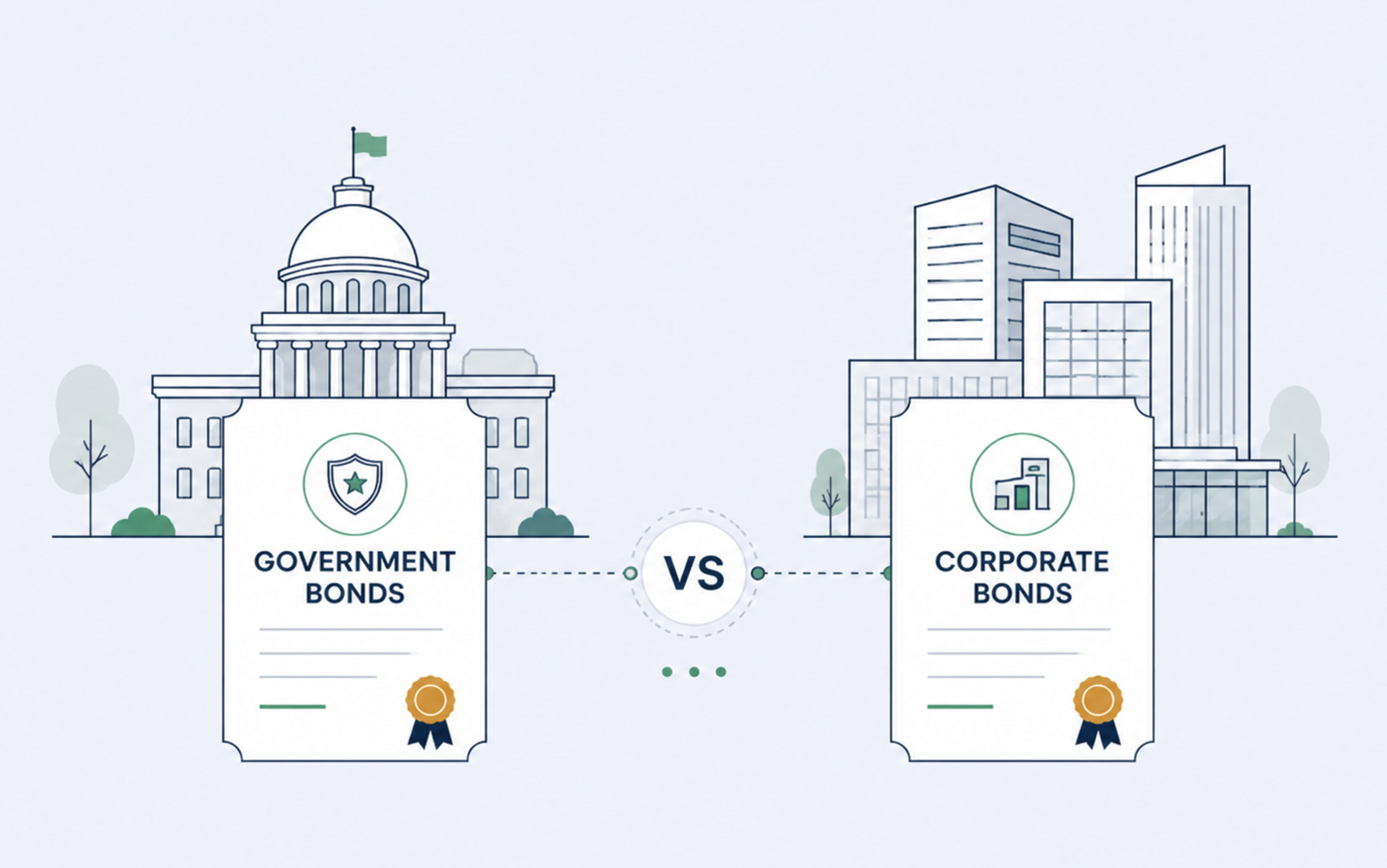
Once you understand that a bond is simply a loan you’re making, the next question follows naturally: who am I lending to? In India, that choice mostly comes down to two families of borrowers - the government and companies. They behave very differently, and picking between them is the first real decision a bond investor makes.
This article walks through both, explains the middle ground most people miss, and shows you how to actually buy each type.
Two borrowers, two very different promises
Think of it like lending money to two people you know. One is a salaried government employee with a rock-steady income and the ability to always find the money somehow. The other is a talented entrepreneur - possibly more rewarding to back, but whose fortunes rise and fall with the business.
You’d probably lend to both. But you wouldn’t charge them the same interest, and you wouldn’t lend them the same share of your savings. That instinct is exactly right, and it’s the whole logic behind government versus corporate bonds.
Government bonds: lending to the sovereign
When the Government of India needs to borrow, it issues Government Securities, commonly called G-Secs. State governments issue their own versions, known as State Development Loans (SDLs). There are also short-term government borrowings called Treasury Bills (T-Bills), which mature in under a year and don’t pay a periodic coupon - instead you buy them at a discount and receive the full face value at maturity.
What makes these special is the borrower. The central government controls the country’s currency and its tax system. In rupee terms, the chance of it failing to repay a rupee loan is considered extremely low - which is why G-Secs are treated as the benchmark for “risk-free” in India. Every other bond in the country is effectively priced by comparing it against a government bond of similar length.
Because that safety is so high, the interest you earn is on the lower side. That’s the deal you’re accepting: maximum security, modest return.
Government bonds tend to suit investors who prioritise safety above all - retirees protecting their capital, conservative savers, or anyone wanting a stable anchor for their portfolio.
Corporate bonds: lending to companies
A corporate bond is money you lend to a company. To attract you away from the safety of a government bond, the company has to offer a higher interest rate. How much higher depends on how financially sound the company is.
This is where a crucial tool enters the picture: the credit rating.
Credit ratings: the report card that sets the price
You can’t personally audit the finances of every company issuing bonds. So specialist agencies - in India, names like CRISIL, ICRA, CARE, and India Ratings - do it for you. They study a company’s finances and assign a grade that signals how likely it is to repay its debt on time.
The grades follow a broadly consistent alphabet. Here’s the intuition, not the exact scale of any single agency:
Rating band | Rough meaning | What it signals |
|---|---|---|
AAA | Highest safety | Very low chance of default |
AA / A | High to adequate safety | Strong, but a notch below the top |
BBB | Moderate safety | The lowest rung still considered “investment grade” |
BB and below | Higher risk | Speculative; meaningful default risk |
D | Default | The issuer has already failed to pay |
Two things are worth burning into memory. First, a rating is an opinion about the future, not a guarantee - good companies can be downgraded, and downgrades can happen faster than upgrades. Second, ratings can change while you hold the bond, which affects both its safety and its resale price.
As a rule of thumb, most first-time investors are best served staying in the AAA and AA space, where the extra yield over government bonds is modest but the risk is contained. The tempting double-digit yields usually live further down the alphabet, and they’re double-digit for a reason.
The middle ground: PSU bonds
Here’s a category many beginners overlook, and it’s a genuinely useful one.
PSU bonds are issued by public sector undertakings - companies owned wholly or partly by the government, in sectors like power, railways, and finance. They sit in an interesting spot: they’re technically corporate bonds, but the government’s ownership gives many of them a perceived backing that pure private companies don’t have.
The practical result is that top-rated PSU bonds often pay a little more than pure government securities, while still being viewed as relatively safe. For an investor who finds G-Sec returns too low but isn’t ready to take on private-company risk, PSU bonds are a sensible middle path. Just remember that “government-owned” is not the same as “government-guaranteed” - read the specific terms of each bond rather than assuming.
Side by side
Feature | Government Bonds (G-Sec / SDL) | Corporate Bonds |
|---|---|---|
Borrower | Central or state government | A company |
Default risk | Very low (sovereign) | Varies with the company |
Typical return | Lower | Higher, to compensate for risk |
Key tool to judge them | The bond’s tenure and government backing | The credit rating |
Who they suit | Safety-first investors | Investors seeking extra yield who understand the risk |
A short, honest myth-check
Myth: “Government bonds always give the lowest returns, so they’re not worth it.” Low return isn’t the same as poor value. In uncertain times, the certainty of getting your money back is itself worth something. A guaranteed 7% can beat a promised 13% that never arrives.
Myth: “A high credit rating means I can’t lose money.” A high rating lowers default risk, but it doesn’t remove price risk. Even a AAA bond can fall in value if you sell it before maturity in a rising-rate environment - a topic we cover in the intermediate articles.
Myth: “PSU means fully government-guaranteed.” Sometimes there’s an explicit guarantee; often there isn’t, just government ownership. These are different things, and the offer document will tell you which applies.
How do you actually buy these in India?
Access has improved dramatically in recent years, and this is worth knowing because it removes the old excuse that “bonds are only for big institutions.”
For government securities, the RBI runs a platform called RBI Retail Direct, which lets individual investors buy G-Secs, SDLs, and T-Bills directly, without going through a middleman, and without transaction charges on the platform itself. It’s the most direct route to sovereign bonds for a retail investor.
For corporate and PSU bonds, SEBI has authorised Online Bond Platform Providers (OBPPs) - regulated digital platforms where you can browse listed bonds, compare their ratings and yields, and buy them, often for as little as ₹10,000 per bond. SEBI reduced the face value of many listed bonds to ₹10,000 specifically to bring ordinary investors into a market that used to demand lakhs per trade. Orders on these platforms are routed through the exchanges’ quote systems for transparency.
You can also buy and sell listed bonds through the secondary market on the NSE and BSE, much as you’d trade shares, using a demat account.
In every case, you’ll need a demat account and completed KYC. The friction that once kept individuals out of the bond market is largely gone.
What this means for you
Choosing between government and corporate bonds isn’t about finding the single “best” one - it’s about matching the borrower to your own comfort with risk.
If your goal is protecting capital and sleeping soundly, lean toward government securities and top-rated PSU bonds.
If you want a bit more income and can stomach some risk, add high-quality corporate bonds (AAA/AA) to the mix.
If you’re tempted by a very high yield, treat it as a red flag to investigate, not a green light to buy.
Above all, don’t put everything in one issuer. Spreading across a few good borrowers is one of the simplest ways to reduce risk.
Most sensible beginner portfolios aren’t purely one type or the other. They’re a blend - a safe government or PSU core, with a measured amount of quality corporate exposure layered on top.
Key takeaways
Government bonds (G-Secs, SDLs, T-Bills) are the safest rupee investments and set the benchmark all other bonds are priced against.
Corporate bonds pay more to compensate for company risk, and you judge that risk using credit ratings from agencies like CRISIL, ICRA, CARE, and India Ratings.
PSU bonds are a useful middle ground - often higher-yielding than pure G-Secs, and generally viewed as safer than private corporate bonds.
Access is now easy: RBI Retail Direct for government bonds, SEBI-regulated OBPPs and the exchanges for corporate bonds, with minimums as low as ₹10,000.
Match the borrower to your risk appetite, and diversify across issuers rather than chasing the highest yield.
This is educational content, not personalized investment advice. Ratings can change, and a AAA rating does not eliminate credit risk; it only estimates it as lower.