
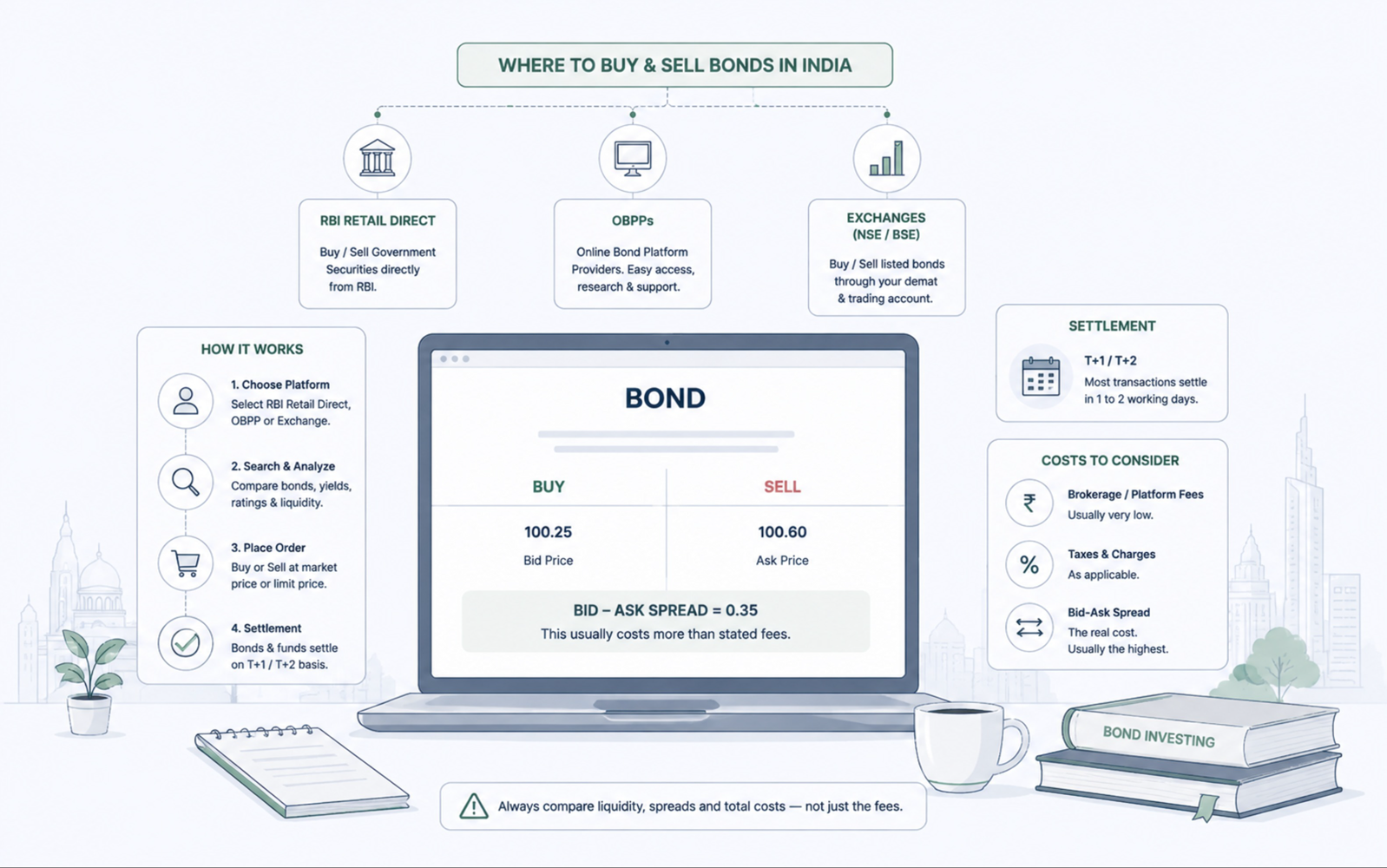
The practical mechanics: RBI Retail Direct vs OBPPs vs the exchanges, settlement, costs, and the point that the bid-ask spread usually costs more than the stated fees.
Understanding bonds and buying one are different skills. The gap between them is where a lot of would-be bond investors stall - not because the process is hard, but because nobody lays it out end to end.
This article closes that gap. It covers where to buy, how the money and the bond actually move, what it costs, and the practical traps that catch people on their first few transactions.
Primary vs secondary: two ways in
Every bond purchase happens in one of two places, and the distinction shapes your experience.
The primary market is when a bond is first issued. The issuer is raising fresh money, and you’re buying directly from them at face value during a defined issue window. Public NCD issues from companies work this way, as do government security auctions. You get a clean, standard price with no accrued interest to worry about - but you can only buy when an issue happens to be open, and the terms are take-it-or-leave-it.
The secondary market is where existing bonds change hands between investors. This is a continuous market - you can buy on any trading day - and it offers far more choice, since every bond ever issued and still outstanding is potentially available. The trade-off is that prices float, and you’ll deal with accrued interest and variable liquidity.
Most ongoing bond investing happens in the secondary market. Primary issues are opportunities you take when they appear; the secondary market is where you build a portfolio on your own schedule.
The three channels for retail investors
1. RBI Retail Direct - for government securities
The RBI operates a platform that lets individual investors buy government securities directly: RBI Retail Direct. You open a Retail Direct Gilt account with the RBI, complete KYC online, and can then participate in government bond auctions (the primary market) and trade on the secondary market for G-Secs.
What makes it notable is the absence of a middleman. You hold government securities directly with the RBI rather than through a broker’s system, and the platform itself doesn’t levy account or transaction charges. For anyone wanting sovereign exposure - Treasury Bills, dated government securities, state development loans, and sovereign gold bonds where available - this is the most direct route.
The trade-off is scope: it’s for government paper. Corporate bonds live elsewhere.
2. Online Bond Platform Providers (OBPPs) - for corporate bonds
SEBI created a licensed category for digital bond platforms called Online Bond Platform Providers. These are registered as debt-segment brokers with the exchanges, and they’ve done more to open the corporate bond market to individuals than anything else in recent years.
On an OBPP you can browse listed bonds filtered by rating, yield, and maturity, see the issuer’s details and offer documents, and buy with a minimum that’s often around ₹10,000 - the face value SEBI reduced privately placed listed bonds to, specifically to bring retail investors in.
An important structural detail worth knowing: SEBI requires OBPPs to route orders through the Request for Quote (RFQ) platform of a recognised stock exchange. That means your trade isn’t happening in a private corner of the platform’s own books - it’s executed through exchange infrastructure with price discovery and settlement handled in the regulated system. When choosing a platform, verify it’s a SEBI-registered OBPP; the registration number is usually displayed in the footer.
3. The exchanges directly - for listed bonds
Listed bonds also trade in the debt segments of the NSE and BSE, accessible through a regular broking account much as you’d buy shares. Enter the ISIN, place your order, and it matches on price-time priority.
This route suits investors already comfortable with a broking terminal. The practical catch is that many bonds trade thinly on the order book, so you may see wide gaps between buy and sell quotes, or no quotes at all.
Channel | Best for | Typical minimum | Key feature |
|---|---|---|---|
RBI Retail Direct | Government securities | Small (G-Sec dependent) | No middleman, no platform charges |
OBPP platforms | Corporate and PSU bonds | Around ₹10,000 | Curated discovery, orders routed via exchange RFQ |
NSE / BSE via broker | Listed bonds, active traders | Varies | Direct order book access |
What you need before you start
The prerequisites are modest:
A demat account, since bonds are held in dematerialised form. Corporate bonds sit in your regular demat account; government securities bought via Retail Direct sit in an RBI gilt account.
Completed KYC - PAN, address proof, and bank details.
A linked bank account, which is where coupons and maturity proceeds are credited automatically.
If you already invest in equities, you likely have everything except the Retail Direct account.
How a purchase actually works
Walking through a secondary-market corporate bond purchase, step by step:
Identify the bond by ISIN. Confirm the exact issuer entity, rating, security, seniority, and whether it’s callable.
Check the YTM, not the coupon. This is your real return at the offered price.
Place the order, specifying quantity and either a market or limit price. On an OBPP this routes to the exchange RFQ platform.
The trade matches, and you receive a contract note confirming price, quantity, and settlement details.
Settlement occurs, typically on a short cycle after the trade date. Funds leave your bank account and the bonds are credited to your demat account.
Coupons arrive automatically in your linked bank account on each payment date, and the face value is credited at maturity.
The number that surprises people
Expect the debited amount to exceed the quoted price. You pay accrued interest to the seller for the days since the last coupon - the difference between the quoted “clean price” and the settled “dirty price.”
An illustrative case: a ₹1,000 face value bond with a 9% annual coupon, bought roughly three months after the last coupon date. Accrued interest is about ₹1,000 × 9% × (3 ÷ 12) = ₹22.50. On a clean price of ₹980, roughly ₹1,002.50 settles.
You haven’t paid a fee. You’ve prepaid interest that returns to you at the next coupon, when you’ll receive the full coupon despite having held the bond for only part of the period. Conventions vary - government securities are typically quoted clean with interest added separately, while exchange-traded corporate bonds commonly settle at the dirty price - but the economics are identical.
What it costs
Bond investing costs are generally modest, but they’re worth knowing so you can spot when they’re not.
Brokerage or platform fees. Some OBPPs charge nothing explicit; RBI Retail Direct levies no platform charges for its transactions.
The bid-ask spread. This is the real, often-invisible cost. It’s the gap between what buyers will pay and what sellers will accept. On a liquid PSU bond the gap may be slim; on a thinly-traded issue it can be wide enough to erase a chunk of your expected return. The spread frequently costs more than the stated fees.
Statutory charges, including exchange transaction charges, stamp duty, and GST on the brokerage component.
Demat charges, depending on your depository participant’s schedule.
For a buy-and-hold investor, these are one-off frictions on a multi-year holding - usually minor. For anyone trading frequently, they compound quickly, and the spread is the item to watch.
Selling before maturity
Buying is the easy half. Selling is where the market’s real character shows.
To sell, you place a sell order through the same channel you’d buy on, and if a buyer is found at an acceptable price, the trade settles and money reaches your account. Straightforward in principle.
The complication is liquidity, and this deserves candour: large parts of the Indian corporate bond market trade thinly. Government securities and large, highly-rated PSU issues generally find buyers at reasonable prices. Smaller issues, lower-rated paper, and privately placed bonds can be genuinely difficult to exit - you may face a wide spread, a long wait, or no bid at all.
Two consequences follow directly:
First, liquidity should be part of your buying decision, not a discovery you make when selling. Before you buy, ask whether this bond trades regularly. If you’re unsure, assume it doesn’t.
Second, treat illiquid bonds as hold-to-maturity commitments. If you buy a thinly-traded bond, plan to hold it to the end. Any money you might need earlier belongs in a genuinely liquid instrument.
There’s a third point worth internalising: liquidity is fair-weather. A bond trading acceptably today can become nearly untradeable during market stress - precisely when investors most want to exit. Never assume today’s liquidity will be there when you need it.
Practical tips that save money
Use limit orders, not market orders, on thinly-traded bonds. With few quotes on the book, a market order can execute at a poor price. A limit order caps what you’ll accept.
Check the record date before buying near a coupon date. Buying just after it means the previous holder receives that coupon.
Compare the same bond across channels. Prices for identical ISINs can differ between platforms.
Match maturity to your actual horizon. The cleanest way to avoid liquidity problems is to not need an early exit.
Confirm the exact issuing entity. Subsidiaries and parents are different borrowers, whatever the shared brand name.
Keep records of purchase price and accrued interest. You’ll need them for capital gains calculations later.
Common mistakes
Buying illiquid bonds with money you might need. The most frequent and most painful error in retail bond investing.
Being alarmed by the dirty price. It’s prepaid interest, recovered at the next coupon.
Ignoring the bid-ask spread while celebrating zero brokerage. A “free” platform with wide spreads can be more expensive than a fee-charging one with tight pricing.
Assuming a listed bond is a liquid bond. Listing means it can trade, not that it does.
Placing market orders on a thin order book. An easy way to overpay.
Skipping the offer document. Call options, security, and seniority live there, and they change what you own.
What this means for you
The machinery of bond investing is more accessible than its reputation suggests: a demat account, a SEBI-registered platform or the RBI’s own portal, and a few careful checks before each order. The friction that once made bonds an institutional preserve has largely been dismantled.
What hasn’t changed is liquidity. Access improved dramatically; the depth of the secondary market improved more slowly. So build with your exit in mind from the start - buy liquid instruments for money that may be needed, and treat everything else as a commitment you intend to see through to maturity. Do that, and the mechanics become routine.
Key takeaways
Bonds are bought in the primary market (new issues at face value) or the secondary market (existing bonds at floating prices).
Three retail channels: RBI Retail Direct for government securities, SEBI-registered OBPPs for corporate bonds, and NSE/BSE through a broker.
Expect to pay the dirty price - the quoted price plus accrued interest - which you recover at the next coupon.
The bid-ask spread often costs more than explicit fees, especially on thinly-traded bonds. Use limit orders.
Liquidity is the binding constraint. Buy liquid instruments for money you may need; treat illiquid bonds as hold-to-maturity commitments.
This is educational content, not personalized investment advice. Ratings can change, and a AAA rating does not eliminate credit risk; it only estimates it as lower.