
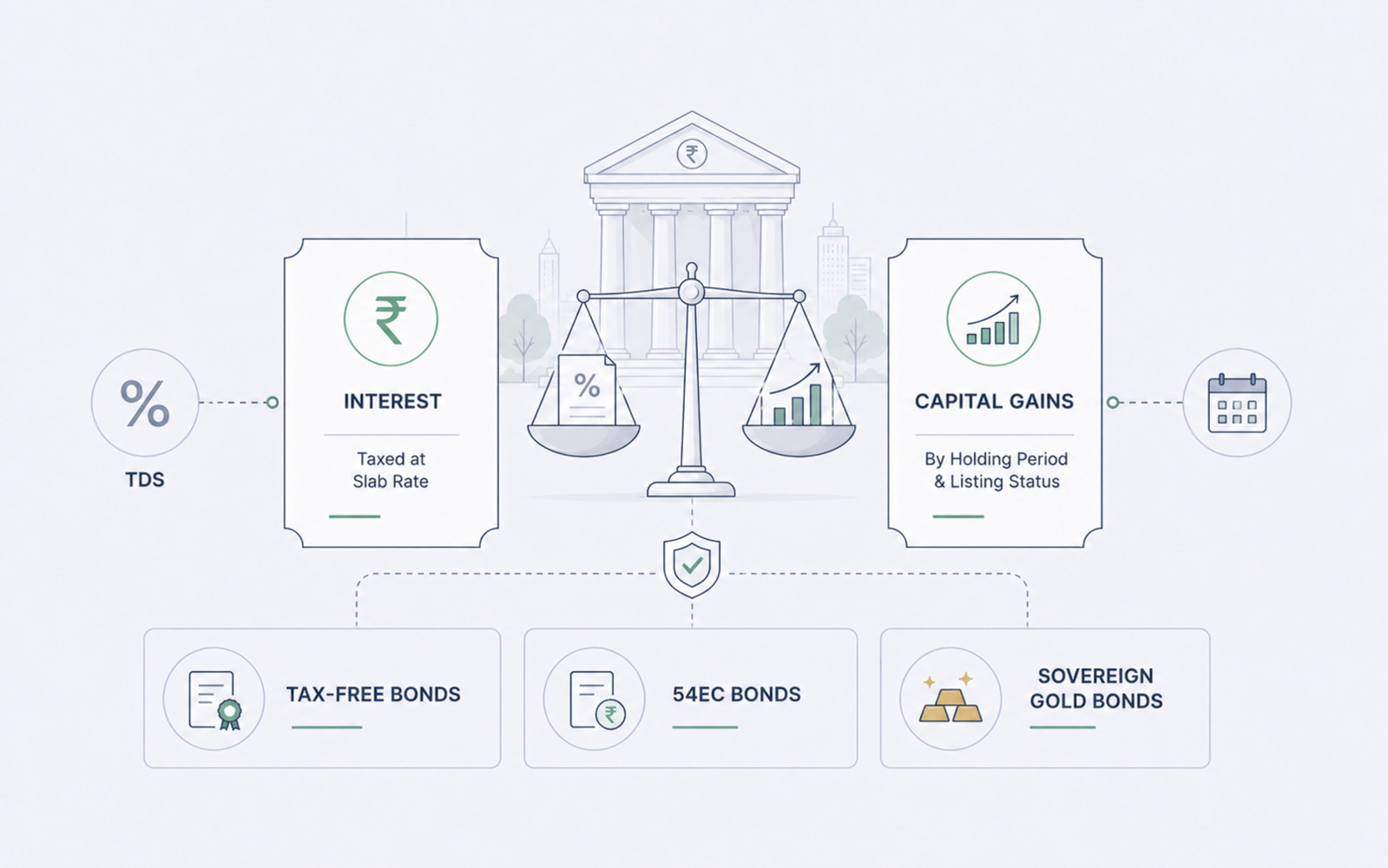
Built around the core split between interest (taxed at slab) and capital gains (by holding period and listing status), then TDS, and the special instruments: tax-free bonds, 54EC capital-gains bonds, and Sovereign Gold Bonds.
There’s a number that matters more than the yield printed on any bond: the amount that’s still yours after tax. Two bonds can advertise the same return and leave very different sums in your bank account, purely because of how each is taxed.
Tax is the part of bond investing that people most often skip and most often get wrong. This guide walks through it in plain language - how your returns are taxed, what gets deducted before the money reaches you, and the few special bonds with their own rules. None of it is complicated once it’s laid out clearly.
A note before we start: tax rules change with each Union Budget, and your own situation affects how they apply. Treat this as a clear map of how things work as of 2026, and confirm specifics for your case with a qualified tax advisor.
Two kinds of return, taxed two different ways
The single most useful thing to understand is that a bond can put money in your pocket in two separate ways, and each is taxed differently.
Interest - the regular coupon payments the bond makes to you.
Capital gains - the profit if you sell the bond, or hold it to maturity, for more than you paid.
Keep these two mentally separate, because almost every confusion about bond tax comes from mixing them up. Let’s take each in turn.
How bond interest is taxed
The coupon payments you receive are treated as ordinary income. They’re added to your total income for the year and taxed at your slab rate - the same rate that applies to your salary.
If you’re in the 30% tax bracket, roughly a third of your interest goes to tax. If you’re in a lower bracket, you pay less; if your total income is below the taxable limit, you may pay nothing on it.
This is the same way a bank fixed deposit’s interest is taxed. On interest alone, bonds get no special treatment - a rupee of bond coupon and a rupee of FD interest are taxed identically. There’s no concession, no special rate. Just your slab.
TDS: tax taken before you’re paid
Here’s something that surprises first-time bond investors. When a company pays you interest, it often deducts a slice of tax before the money reaches you and deposits that slice with the government on your behalf. This is TDS - Tax Deducted at Source.
For bond interest, TDS is generally deducted at 10% once your interest from that issuer crosses a threshold in a financial year (₹10,000 under current rules). If you haven’t given the issuer a valid PAN, the rate jumps to 20%, so always ensure your PAN is registered and active.
Three things to know so this never confuses you:
TDS is not an extra tax. It’s an advance payment against your final tax bill. When you file your return, TDS already paid is adjusted against what you owe. If too much was deducted, you get a refund; if your slab rate is higher, you pay the difference.
Government securities are generally exempt from TDS for resident investors - but the interest is still taxable at your slab rate. No TDS doesn’t mean no tax; it just means you settle it yourself when you file.
If your income is below the taxable limit, you can submit a self-declaration to the issuer to avoid TDS being deducted in the first place, so you don’t have to wait for a refund.
Always check your Form 26AS (your tax credit statement) to confirm the TDS deducted on your bonds before filing, so you claim full credit for it.
How capital gains on bonds are taxed
Now the second kind of return. If you sell a bond for more than you paid - or buy it below face value and hold it to maturity - the profit is a capital gain. How it’s taxed depends on two things: how long you held the bond, and whether the bond is listed on a stock exchange.
This listed-versus-unlisted distinction genuinely matters, so here it is clearly:
Bond type | Holding period | How the gain is taxed |
|---|---|---|
Listed | 12 months or less | Short-term - added to income, taxed at slab rate |
Listed | More than 12 months | Long-term - flat 12.5%, without indexation |
Unlisted | Any period | Treated as short-term - taxed at slab rate |
(Reflects rules for transfers on or after 23 July 2024.)
Read that table twice, because it holds a real insight. For a listed bond held more than a year, long-term gains are taxed at a flat 12.5%. For someone in the 30% bracket, that’s meaningfully lighter than paying slab rate. This is the one structural tax advantage bonds can offer over fixed deposits - but it applies to the capital gain portion of a listed bond, not to interest.
For unlisted bonds and debentures, that advantage disappears. Under current rules, gains on them are treated as short-term no matter how long you hold, and taxed at your slab rate. So two bonds with identical yields can leave you with different after-tax amounts purely based on whether one is listed.
One more term to retire: indexation. It used to let you inflate your purchase cost to reduce taxable gains on long-held bonds. That benefit has been removed across bond categories. It’s worth knowing the word only so you recognise that older articles mentioning it are now out of date.
Putting interest and gains together
Let’s make it concrete with an illustrative example. Suppose you buy a listed bond below its face value, hold it for two years, collect coupons along the way, and it matures at face value.
The coupons you received each year were taxed at your slab rate as interest.
The difference between your discounted purchase price and the face value you received at maturity is a long-term capital gain (listed, held over a year), taxed at the flat 12.5%.
So your total return was taxed in two pieces, at two different rates. For a higher-bracket investor, structuring some return as a capital gain rather than as interest can improve what you keep - which is exactly why the price you pay for a listed bond matters for tax, not just for return.
A few special bonds with their own rules
Beyond ordinary bonds, a handful of instruments have distinct tax treatment worth knowing about.
Tax-free bonds. These were issued in past years by certain government-backed entities, and their defining feature is that the interest is completely exempt from tax under the Income Tax Act. That makes them especially attractive to higher-bracket investors. The catch: no new ones are being issued, so they’re only available in the secondary market. Note that while the interest is tax-free, any capital gain from selling them is still taxable.
54EC capital gains bonds. These serve a very specific purpose: saving tax when you sell property. If you make a long-term capital gain on selling land or a building, investing that gain (up to ₹50 lakh in a financial year) in these bonds within six months lets you claim an exemption on it. They’re issued by AAA-rated public sector companies such as REC, PFC, and IRFC, carry a five-year lock-in, and currently pay around 5.25%. Important: the interest they pay is still taxable at your slab rate - the tax benefit is only on the capital gain you reinvested, not on the bond’s income.
Sovereign Gold Bonds (SGBs). These government bonds track the price of gold and pay a small additional interest (around 2.5% a year), which is taxable at your slab rate. Their standout feature: if you hold to maturity, the capital gain from the increase in gold’s price is exempt from tax for individual investors. If you sell early in the secondary market instead, normal capital gains rules apply. (No new tranches have been issued recently, so check current availability before planning around them.)
What this means for you
The practical takeaway is simple to state and easy to forget: compare bonds on their after-tax return, not their headline yield. A bond’s advertised yield is a pre-tax number, and your tax bracket can change the ranking of two options entirely.
A few habits that follow directly:
Know your slab. It determines how heavily your interest is taxed and whether a listed bond’s capital gains treatment helps you.
Notice whether a bond is listed. For long-term holdings, listed bonds can be more tax-efficient than unlisted ones.
Keep your records. Save your purchase price and any accrued interest paid - you’ll need them to calculate capital gains correctly.
Register your PAN and check Form 26AS. This avoids the 20% TDS rate and ensures you get credit for tax already deducted.
Don’t let tax alone drive the decision. A tax-efficient bond from a weak issuer is still a weak bond. Tax is one input, not the whole picture.
Tax won’t make a bad bond good. But understanding it ensures you’re comparing your real options fairly - and, for higher-bracket investors especially, it occasionally reveals that the bond with the lower headline yield is the one that leaves you richer.
Frequently asked questions
1. How is bond interest taxed in India? Coupon interest is added to your total income and taxed at your slab rate, exactly like fixed deposit interest. There’s no special rate or concession for ordinary bond interest.
2. What is TDS on bonds, and is it an extra tax? TDS is tax deducted by the issuer before paying you interest - generally 10% above a threshold, or 20% without a valid PAN. It’s not extra; it’s an advance against your final tax, adjusted or refunded when you file your return.
3. How are capital gains on bonds taxed? For listed bonds, gains are short-term (taxed at slab rate) if held 12 months or less, and long-term (flat 12.5%, no indexation) if held longer. Gains on unlisted bonds are treated as short-term and taxed at slab rate regardless of holding period.
4. Are listed bonds more tax-efficient than unlisted bonds? For long-term holdings, generally yes. Long-term gains on listed bonds are taxed at a flat 12.5%, while gains on unlisted bonds are taxed at slab rate. The advantage is larger for higher-bracket investors.
5. What are tax-free bonds? Bonds issued in past years by government-backed entities whose interest is fully exempt from tax. No new ones are being issued, so they’re only available in the secondary market. Capital gains on selling them remain taxable.
6. Do 54EC bonds make my interest tax-free? No. 54EC bonds help you save tax on capital gains from selling property by reinvesting the gain. The interest they pay is still taxable at your slab rate.
7. How are Sovereign Gold Bonds taxed? Their annual interest (around 2.5%) is taxable at your slab rate. If you hold to maturity, the capital gain from gold’s price rise is exempt for individuals; selling early in the market attracts normal capital gains tax.
Key takeaways
Bond returns come in two forms - interest (taxed at your slab rate) and capital gains (taxed by holding period and listing status).
TDS on interest is generally 10% (20% without PAN) and is an advance against your final tax, not an extra charge.
Listed bonds held over 12 months get a flat 12.5% long-term gains rate; unlisted bond gains are taxed at slab rate regardless of holding period.
Indexation has been removed across bond categories - older guidance mentioning it is outdated.
Special bonds have special rules: tax-free bonds (exempt interest), 54EC bonds (property gains exemption), and SGBs (tax-free maturity gains for individuals).
Always compare bonds on after-tax return, and confirm current rules with a tax advisor.
This is educational content, not personalized investment advice. Ratings can change, and a AAA rating does not eliminate credit risk; it only estimates it as lower.