
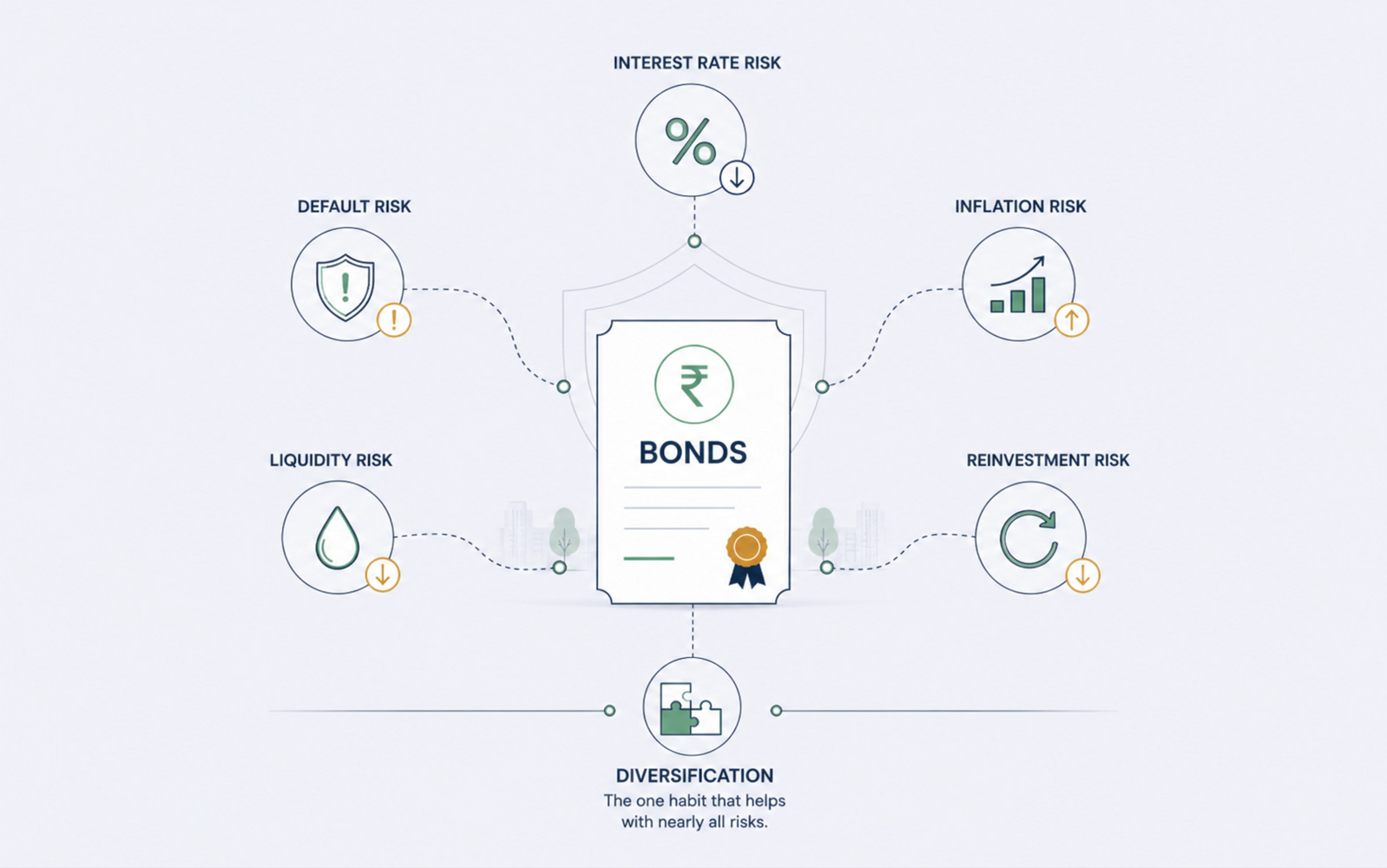
A plain map of the five main risks (default, interest-rate, inflation, liquidity, reinvestment), each with when-it-matters and how-to-manage, plus diversification as the one habit that helps with nearly all of them.
Bonds have a reputation for being “safe.” It’s a useful reputation, and for the right bonds it’s largely deserved - but taken too literally, it’s misleading. Bonds carry several distinct risks, and the investors who get hurt are usually the ones who believed the reputation without understanding the reality.
The good news is that bond risks are understandable and, for the most part, manageable. This guide maps out the main ones in plain language, explains when each matters, and shows the simple habits that keep them in check.
First, a helpful reframe
“Is this bond safe?” is the wrong question, because it has no single answer. A Government of India bond and a small company’s bond are both “bonds,” yet they carry wildly different risks.
The better question is: “What are the specific risks of this particular bond, and can I live with them?” Once you can name the risks, you can judge and manage them. So let’s name them.
Risk 1: Default risk (will you be repaid?)
This is the risk most people think of first: the chance that the borrower fails to pay your interest or return your principal. It’s also called credit risk.
Default risk depends entirely on the borrower. The Government of India, which controls the rupee and collects taxes, has an extremely low chance of failing to repay a rupee bond. A financially shaky company has a much higher chance. This is why different bonds pay different interest rates - a riskier borrower must offer more to persuade you to lend.
When it matters most: with lower-rated corporate bonds, and especially with any bond offering a yield far above the market. That extra yield is compensation for extra default risk, not a free bonus.
How to manage it: - Use credit ratings (AAA, AA, and so on) as a starting guide to a borrower’s strength. - Diversify across issuers so that no single default can seriously hurt you. This is the most important defence, because even good borrowers occasionally disappoint. - Be suspicious of unusually high yields - treat them as a question to investigate, not a deal to grab.
Risk 2: Interest rate risk (the price can move)
This is the risk that catches people who assumed bonds never lose value. Even a perfectly safe government bond can fall in price, because of how bonds respond to interest rates in the economy.
The rule is simple: when interest rates rise, the market price of existing bonds falls; when rates fall, existing bond prices rise. Think of it as a seesaw between rates and prices.
Why does this happen? Suppose you hold a bond paying 7%, and new bonds start being issued at 9%. Your 7% bond is now less attractive, so if you tried to sell it, buyers would only pay a lower price. Nothing is wrong with your bond - the market simply reprices it to compete with newer, higher-paying ones.
When it matters most: if you might sell before maturity, and especially with long-dated bonds, whose prices swing more when rates move. If you hold a healthy bond all the way to maturity, you receive your coupons and face value regardless of these interim swings.
How to manage it: - Match the bond’s maturity to when you’ll need the money, so you’re not forced to sell early at a bad price. - Favour shorter maturities if you’re worried about rising rates, since their prices move less. - Consider spreading your bonds across different maturities so you’re not exposed to one moment in the rate cycle.
Risk 3: Inflation risk (the quiet one)
This is the risk people notice least and it can quietly cost the most. Inflation risk is the danger that rising prices erode the real value of your bond’s fixed payments over time.
A bond pays you fixed rupee amounts. But if the cost of living rises faster than expected, those fixed rupees buy less each year. You might receive exactly what was promised and still end up poorer in real terms, because your money’s purchasing power shrank.
An illustrative way to see it: if your bond pays 6% and inflation runs at 5%, your real return - what you actually gained in buying power - is only about 1%. The headline looked fine; the reality was thin.
When it matters most: with long-term bonds locked at low fixed rates, during periods of high or rising inflation.
How to manage it: - Compare a bond’s yield against expected inflation to gauge your real return, not just the headline number. - Don’t lock large sums into very long, low-yielding bonds when inflation is a concern. - Remember this risk exists even for “safe” government bonds - safety from default is not safety from inflation.
Risk 4: Liquidity risk (can you sell when you want?)
Liquidity risk is the chance that you can’t sell your bond quickly at a fair price when you want to.
Some bonds - government securities and large, highly-rated bonds - trade actively, so buyers are usually available. But many smaller or lower-rated bonds trade thinly. You might struggle to find a buyer, or only find one willing to pay a poor price. And liquidity tends to vanish exactly when markets are stressed and you most want to exit.
When it matters most: with smaller, lower-rated, or privately placed bonds, and during market turbulence.
How to manage it: - Keep money you might need soon in liquid instruments - highly-rated bonds, government securities, or simply a savings vehicle. - Treat thinly-traded bonds as hold-to-maturity commitments, and only buy them with money you won’t need early. - Ask, before buying, whether a bond trades regularly. If you can’t tell, assume it doesn’t.
Risk 5: Reinvestment risk (the follow-on problem)
A subtler one, worth a mention. Reinvestment risk is the chance that when your bond pays you a coupon, or matures, you can only reinvest that money at lower rates than before.
If you’re relying on a certain level of income, a period of falling rates means each coupon you receive, and each bond that matures, gets reinvested at less attractive rates than you were used to.
How to manage it: spreading your bonds across different maturities helps, since only part of your money comes up for reinvestment at any one time, smoothing the effect of rate changes.
The risks at a glance
Risk | The danger | Worst for | Simplest defence |
|---|---|---|---|
Default | Borrower doesn’t repay | Low-rated bonds | Ratings + diversify across issuers |
Interest rate | Price falls if rates rise | Long bonds, early sellers | Match maturity to your need |
Inflation | Fixed payments lose value | Long, low-yield bonds | Check your real (after-inflation) return |
Liquidity | Can’t sell at a fair price | Small, low-rated bonds | Keep near-term money in liquid assets |
Reinvestment | Reinvesting at lower rates | Falling-rate periods | Spread across maturities |
The one habit that manages all of them
If there’s a single practice that reduces almost every risk above, it’s diversification - spreading your money across different issuers, different maturities, and different types of bonds.
Diversification directly softens default risk (one failure can’t sink you), interest rate risk (you’re not tied to one point in the cycle), and reinvestment risk (only part of your money reinvests at once). It’s not glamorous, and it won’t make you rich quickly, but it’s the closest thing bond investing has to a universal safeguard. The investors who run into serious trouble are almost always the ones who concentrated too much in one bond, one issuer, or one bet.
What this means for you
Bonds are not risk-free, but their risks are unusually knowable. Unlike many investments, you can name what might go wrong with a bond, judge how likely it is, and take specific steps to reduce it. That’s a real advantage.
The mindset that serves you best isn’t “bonds are safe” or “bonds are risky” - it’s “this particular bond carries these particular risks, and here’s how I’m handling them.” Approach each bond that way, diversify sensibly, match your bonds to when you’ll need the money, and you’ll have managed the large majority of what can go wrong. That’s not the absence of risk; it’s the intelligent handling of it, which is what investing actually is.
Key takeaways
Bonds carry several knowable risks: default, interest rate, inflation, liquidity, and reinvestment.
Default risk depends on the borrower - manage it with ratings and, above all, diversification across issuers.
Interest rate risk means prices fall when rates rise; match a bond’s maturity to when you’ll need the money.
Inflation risk quietly erodes fixed payments - always check your real, after-inflation return.
Liquidity risk means you may not be able to sell at a fair price - keep near-term money in liquid instruments.
Diversification softens nearly every one of these risks and is the single most useful habit.
This is educational content, not personalized investment advice. Ratings can change, and a AAA rating does not eliminate credit risk; it only estimates it as lower.