
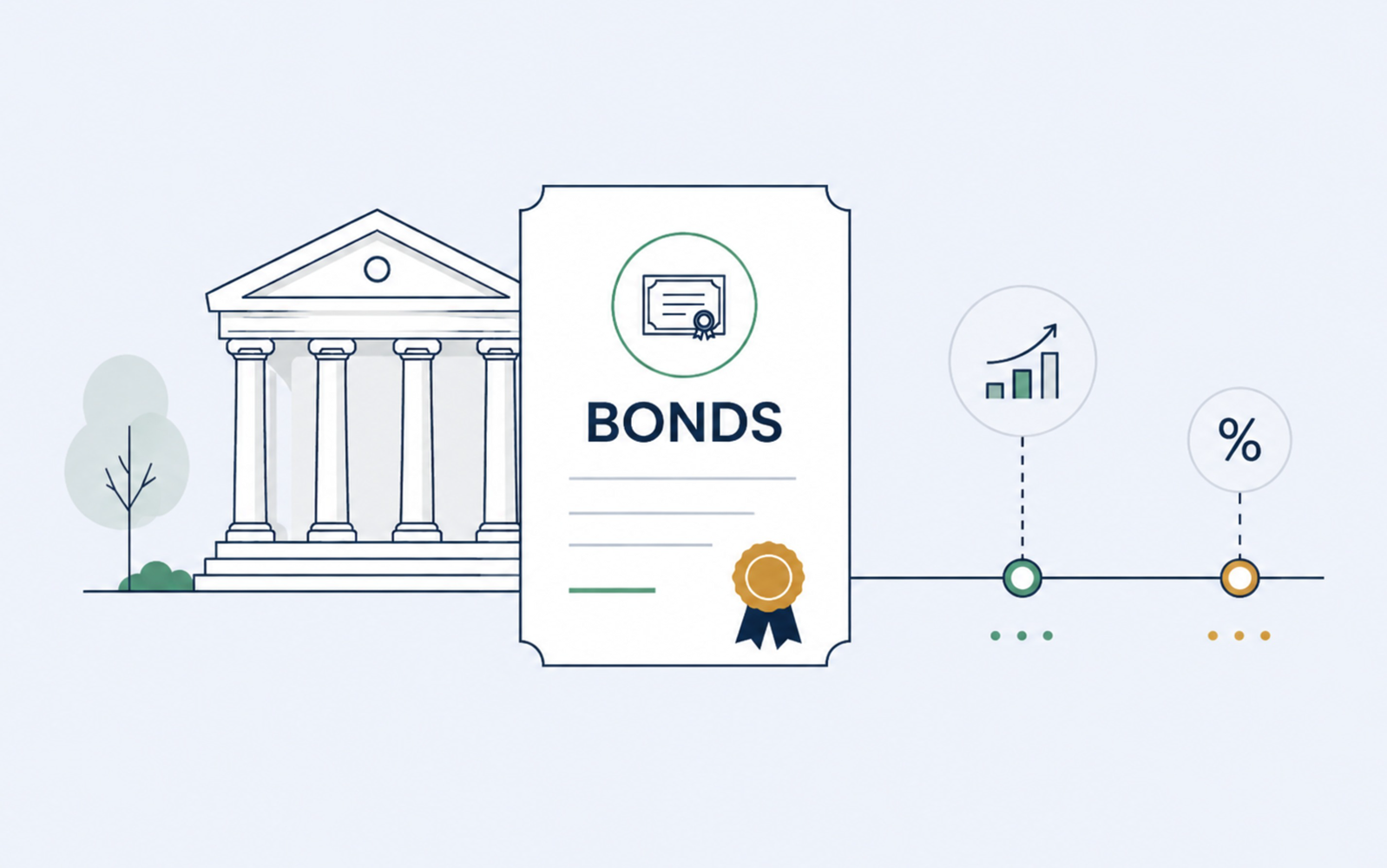
Strip away the jargon: a bond is just an IOU with a schedule. Here's how to read one.
What Are Bonds? A Plain-English Guide for Indian Investors
Most of us learn to save before we learn to invest. We open a bank account, then a fixed deposit, and for years that feels like the whole map. Bonds sit right next to those familiar options, yet a lot of people never look at them closely - partly because the word sounds technical, and partly because nobody ever explained them in ordinary language.
So let’s fix that. By the end of this article you’ll understand what a bond is, how it puts money in your pocket, and where it fits alongside the fixed deposit you already know.
The one-line version
A bond is a loan - but you’re the lender, not the borrower.
When a company or a government needs money, it has two broad choices. It can sell a piece of ownership (that’s what a share is), or it can borrow. A bond is how it borrows from the public. You hand over a fixed sum today, the borrower promises to pay you regular interest for an agreed period, and at the end they return your original amount.
If you’ve ever lent ₹10,000 to a cousin who promised “I’ll pay you 8% a year and give the full amount back in three years,” you already understand the mechanics of a bond. A bond simply writes that promise down formally, gives it a standard structure, and - importantly - lets you sell that promise to someone else if you want your money back early.
The four numbers that define every bond
Every bond, no matter how complicated it looks, is built from four basic pieces of information. Once you can read these four, you can read almost any bond.
Term | What it means | Everyday translation |
|---|---|---|
Face value | The amount printed on the bond, repaid at the end | The size of the loan per unit |
Coupon | The interest rate the issuer pays you | Your yearly “rent” on the money |
Maturity | The date the borrower returns your face value | When the loan ends |
Issuer | Who borrowed the money | Who owes you |
Here’s an illustrative example. Suppose a company issues a bond with a face value of ₹1,000, a coupon of 9%, and a maturity of five years. If you buy one unit, you’re lending ₹1,000. Every year you receive ₹90 in interest (9% of ₹1,000). After five years, the company hands back your ₹1,000 and the arrangement is over. Across those five years you’d have received ₹450 in interest plus your original ₹1,000 back.
The coupon can be paid annually, half-yearly, or quarterly depending on the bond. The frequency doesn’t change the total interest much, but more frequent payments are handy if you’re relying on the income to cover regular expenses - something retirees often care about.
Why do bonds even exist? Follow the money
It helps to understand why a borrower would issue a bond instead of just walking into a bank.
Imagine a road-building company that needs ₹500 crore for a new project. A single bank might hesitate to lend that entire amount to one borrower - it’s a lot of risk in one place. So instead, the company breaks the loan into small, standardised pieces and sells them to thousands of investors. Each investor takes a tiny slice of the risk, and the company gets its ₹500 crore.
Governments do the same thing on a much larger scale. When the Government of India spends more than it collects in taxes, it borrows the difference by issuing bonds called Government Securities, or G-Secs. State governments issue their own version, called State Development Loans. This is genuinely how a large part of public spending gets funded.
So a bond exists because it’s often cheaper and more flexible for the borrower - and it exists as an investment because that borrower is willing to pay you interest for the privilege of using your money.
How is this different from a fixed deposit?
This is the question most first-time bond investors actually care about, because the FD is the benchmark everyone in India measures against.
A fixed deposit is, in spirit, a bond that only your bank issues. You lend the bank money, it pays you interest, and it returns your principal at the end. The differences are in the details, and the details matter.
Feature | Fixed Deposit | Bond |
|---|---|---|
Who you’re lending to | Your bank | A government, PSU, or company |
Interest rate | Set by the bank | Depends on the issuer’s risk and the market |
Can you sell it early? | Usually only by breaking it (with a penalty) | Yes, many bonds trade in a market |
Safety cushion | Deposits insured up to ₹5 lakh per bank | Depends entirely on the issuer |
Range of returns | Narrow | Wide - from very safe to high-risk |
Notice the trade-off hiding in that table. A bank FD is simple and comes with deposit insurance up to ₹5 lakh, which is genuinely reassuring. But you’re limited to whatever rate your bank offers. Bonds open up a wider menu: you can lend to the Government of India (about as safe as it gets in rupee terms) or to a company willing to pay more because it carries more risk. You choose where on that spectrum you want to sit.
The other real difference is liquidity. Break an FD early and you typically lose some interest. Many bonds, by contrast, can be sold to another investor in what’s called the secondary market - though the price you get will depend on market conditions that day, which is a nuance we’ll return to in later articles.
“So how much can I actually make?”
Returns depend on the issuer and the market at the time, so no honest article can quote you a fixed number. But the logic is consistent: the safer the borrower, the lower the interest; the riskier the borrower, the higher the interest they must offer to attract lenders.
A Government of India bond will pay less than a well-run private company’s bond, which in turn will pay less than a shaky company desperate for cash. That extra interest on the riskier bonds isn’t a gift - it’s compensation for the chance that you might not get paid back. Understanding that single sentence protects you from the most common beginner mistake, which we’ll get to now.
The mistake beginners make most often
New investors tend to scan a list of bonds and pick the one with the highest interest rate. It feels logical - more interest, more money.
But a high coupon is often a warning label, not a bargain. If a company is offering 14% when government bonds pay around 6–7%, the market is telling you something: investors believe there’s a real chance this borrower could struggle to repay. Sometimes that risk is worth taking. Often, for a beginner, it isn’t. The interest rate is not just a reward - it’s a rough score of how nervous the market is about getting its money back.
The skill in bond investing isn’t finding the highest number. It’s understanding what you’re being paid for.
What this means for you
If you’re coming from a world of savings accounts and fixed deposits, think of bonds as an expansion of your options, not a replacement for everything you know. They let you:
Lend to safer borrowers than your bank (like the Government of India) if security is your priority.
Earn more than an FD if you’re willing to take on a bit more risk with a well-rated company.
Build predictable income through regular coupon payments, which suits retirees and anyone wanting steady cash flow.
Access your money more flexibly, since many bonds can be sold before maturity.
None of this requires you to become a market expert overnight. It just requires you to read those four numbers - face value, coupon, maturity, issuer - and understand what each one is telling you.
Frequently asked questions
1. Are bonds safe? It depends entirely on who issued them. A Government of India bond carries very low risk of default because the government controls the rupee. A small company’s bond can be quite risky. “Bonds” as a category aren’t safe or unsafe - the issuer decides that.
2. Can I lose money on a bond? In two ways. If the issuer fails to pay (default), you can lose interest or principal. And if you sell a bond before maturity, you might get less than you paid, because bond prices move with market conditions. If you hold a healthy bond to maturity, you receive your coupons and face value as promised.
3. How much money do I need to start? Less than you might think. Regulators have reduced the minimum investment for many listed corporate bonds to ₹10,000, and small government securities are accessible too. You no longer need lakhs to begin.
4. How is a bond different from a debt mutual fund? When you buy a bond, you own that specific loan and know your exact coupon and maturity. A debt mutual fund pools money and buys many bonds on your behalf, run by a fund manager, with no fixed maturity for you. Both invest in bonds; one is direct, the other is managed.
5. Do bonds pay interest into my bank account? Yes. Coupon payments are typically credited directly to your registered bank account on the schedule set by the bond, and the face value is returned at maturity.
6. Are bond returns taxed? Yes, and the rules differ for interest income versus gains from selling early. Taxation is important enough that we cover it properly in a dedicated section of a later article.
Key takeaways
A bond is a loan where you are the lender. You get regular interest (the coupon) and your money back at maturity.
Every bond is defined by four numbers: face value, coupon, maturity, and issuer.
Bonds and fixed deposits are cousins - but bonds offer a wider range of borrowers, returns, and the ability to sell early.
A higher interest rate usually signals higher risk, not a better deal. Understand what you’re being paid for.
You can start with modest amounts, thanks to lower minimum investment sizes in recent years.
This is educational content, not personalized investment advice. Ratings can change, and a AAA rating does not eliminate credit risk; it only estimates it as lower.