
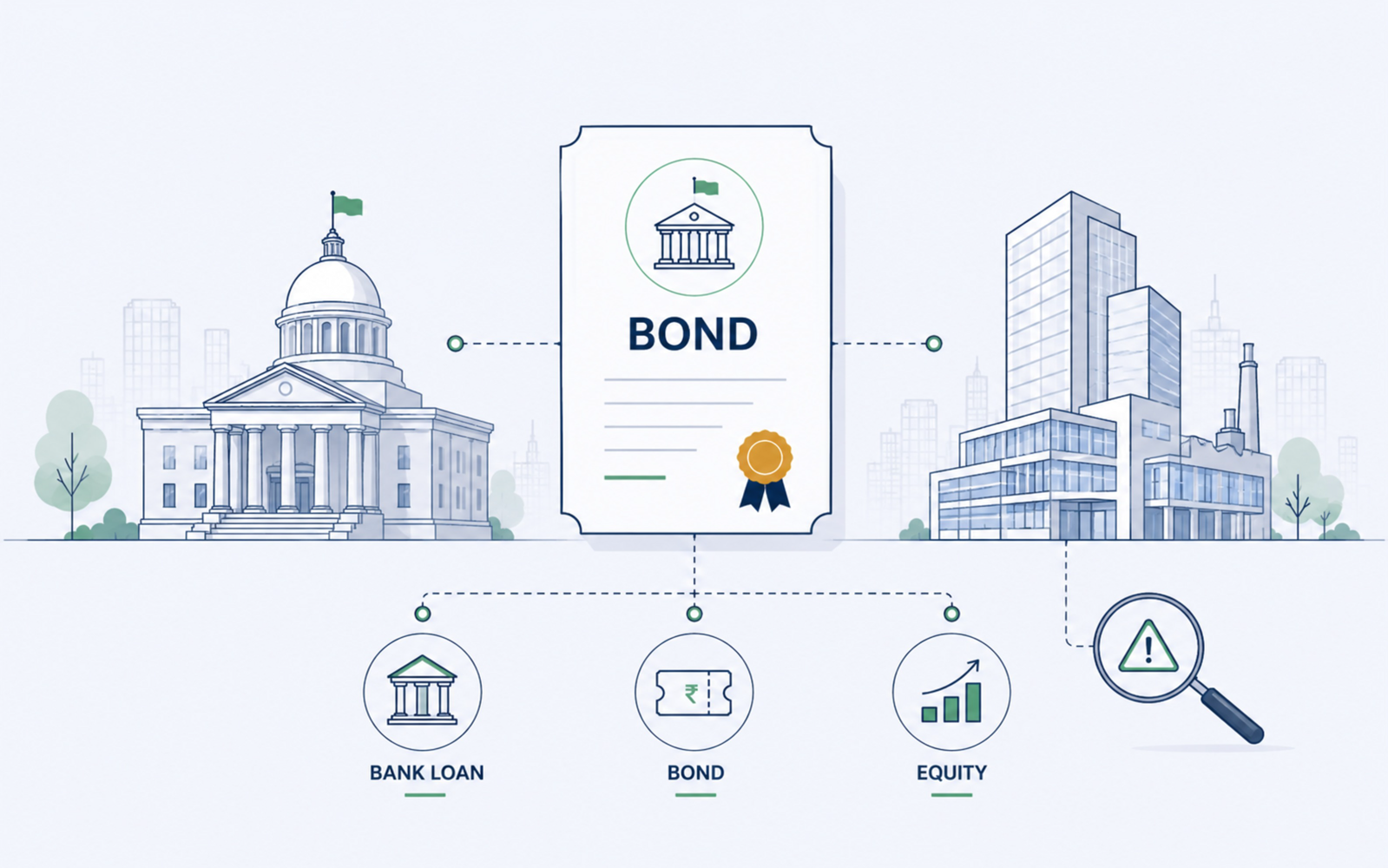
The borrower's side (bonds vs bank loans vs equity), why governments are the largest issuers, and how "why is this entity borrowing?" doubles as a risk signal.
Most bond guides explain what a bond does for you - the interest, the maturity, the return. Far fewer explain the other side of the deal: why the borrower chose to issue a bond in the first place.
That’s a gap worth closing, because understanding the borrower’s motivation makes you a sharper investor. When you know why an entity is borrowing, you’re better placed to judge whether lending to it is a good idea. So let’s flip the usual perspective and look at bonds from the borrower’s chair.
The basic need: borrowers need money
Every bond starts with an entity that needs money it doesn’t currently have. A company wants to build a factory. A government wants to fund infrastructure and services. A power utility needs to lay transmission lines. These are large, expensive undertakings, and the money has to come from somewhere.
Broadly, an organisation that needs money has three options:
Use its own cash - often insufficient for big projects, and it drains reserves.
Borrow it - take on debt to be repaid with interest.
Sell ownership - for a company, issue shares and bring in new part-owners.
A bond is a specific, powerful version of option two. To understand why borrowers choose it, we need to see what it offers that the alternatives don’t.
Why borrow by issuing a bond instead of taking a bank loan?
This is the key question, because at first glance a bank loan seems simpler. Why go to the trouble of issuing a bond to thousands of investors when you could just borrow from one bank?
Several real advantages explain it.
You can raise very large sums. A single bank may be unwilling or unable to lend the entire amount a big project needs - it’s too much risk concentrated in one borrower. By issuing a bond, the borrower splits that large requirement into thousands of small pieces sold to many investors. Each investor takes a manageable slice, and together they fund an amount no single lender would comfortably provide.
It can be cheaper. A bank has to make a profit on the money it lends, so its loan rate includes that margin. When a strong borrower issues a bond, it can often borrow directly from investors at a lower rate than a bank would charge - cutting out part of the middleman’s cost. For a large, creditworthy issuer, that saving on a big sum is substantial.
The terms can be tailored. A borrower issuing a bond can design it to fit its needs - choosing the maturity, the coupon, whether interest is paid yearly or at the end, and other features. A bank loan is more of a fixed product; a bond can be shaped around the project it’s funding.
It doesn’t dilute ownership. For a company, the alternative way to raise big money is selling shares - but that means giving away a piece of the company and sharing future profits and control with new owners forever. A bond does no such thing. The company borrows, pays interest, repays the principal, and the arrangement ends. The original owners keep full ownership. For a profitable company confident in its future, borrowing is often more attractive than selling equity.
Put together, these advantages explain why bonds are a favourite tool of large borrowers. They unlock scale, cost savings, flexibility, and control that other methods can’t match all at once.
Why governments are the biggest issuers of all
Governments issue more bonds than anyone, and their reason is structural.
A government’s spending - on infrastructure, defence, welfare, salaries, and countless services - routinely exceeds what it collects in taxes in a given year. That shortfall has to be financed, and governments finance it by borrowing. The main way they borrow is by issuing bonds.
When the Government of India issues these bonds, called Government Securities or G-Secs, it’s borrowing from the public and from institutions to bridge the gap between spending and revenue. State governments do the same through their own bonds. This isn’t a sign of trouble - it’s the normal, everyday machinery of public finance, used by virtually every country.
For an investor, this matters enormously, because it means there’s a constant, large, and reliable supply of bonds from the safest rupee borrower in the country. The government’s ability to tax and to issue currency is why its bonds are treated as the benchmark for safety, and why they anchor the entire bond market.
Why a company’s reason for borrowing matters to you
Here’s where the borrower’s perspective becomes a practical investing tool. Why a company is raising money tells you something about the risk of lending to it.
Consider the difference between these two borrowers:
A profitable company issuing a bond to build a new plant that will expand its earnings. It’s borrowing to grow, and the project should generate the cash to repay you.
A struggling company issuing a bond to repay older debt it can’t otherwise clear. It’s borrowing to plug a hole, not to grow, and its ability to repay you is far less certain.
Both are “issuing a bond.” But they’re very different propositions. The first is a healthy borrower funding expansion; the second may be a warning sign. A company that keeps borrowing simply to repay previous borrowings is running on a treadmill that can eventually stop.
You won’t always find the reason spelled out plainly, but the offer document and the company’s disclosures usually indicate what the money is for. Asking “why does this borrower need my money?” is one of the simplest and most revealing questions a bond investor can ask.
How a bond actually gets issued
To complete the picture, here’s roughly how a bond comes into existence - the primary market, where bonds are born.
The borrower decides how much it needs and designs the bond’s terms.
A credit rating is obtained (for corporate bonds) so investors can judge the risk.
The bond is offered to investors during an issue window - this is the “primary market.” Investors buy directly from the issuer, usually at face value.
The borrower receives the money it raised and puts it to work.
The borrower pays coupons over the bond’s life and returns the face value at maturity.
After this, the bond can change hands between investors in the “secondary market” - but the issuance itself, the moment the bond is created and the borrower gets funded, happens in the primary market. For you as an investor, primary issues are opportunities to buy at standard terms; the secondary market is where you buy existing bonds on your own schedule.
A common misunderstanding
Beginners sometimes assume that a company issuing bonds must be short of money or in difficulty. Usually the opposite is true.
Healthy, growing companies issue bonds all the time - it’s a normal, efficient way to fund expansion without giving up ownership. Issuing debt is often a sign of confidence: the company expects to earn enough to comfortably pay the interest and repay the principal. The concern isn’t that a company borrows; it’s why and how much. A modest bond to fund a sensible project is healthy. Heavy borrowing to survive is not. The act of issuing isn’t the warning sign - the purpose behind it might be.
What this means for you
Seeing bonds from the borrower’s side changes how you evaluate them. A bond isn’t just a product handed to you; it’s the result of a real decision by a real organisation that needed money and chose this way to get it. That decision carries information.
When you look at a bond, spend a moment on the borrower’s side of the deal:
Who is borrowing, and are they strong enough to repay? This is your core credit question.
Why are they borrowing - to grow, or to survive? Growth borrowing is generally healthier than distress borrowing.
Does the amount seem sensible relative to their size? A borrower drowning in debt is riskier regardless of the reason.
Understanding why bonds exist doesn’t just satisfy curiosity - it hands you a set of questions that make you a more careful lender. And careful lending is what successful bond investing ultimately is.
Key takeaways
Borrowers issue bonds to raise large sums from many investors, often more cheaply than a bank loan and without giving up ownership.
Governments are the biggest issuers, borrowing to bridge the gap between spending and tax revenue - normal public finance, and the anchor of the bond market.
Why a company borrows is a risk signal: borrowing to grow is generally healthier than borrowing to repay old debt.
Bonds are created in the primary market, then trade between investors in the secondary market.
A company issuing bonds is usually a sign of confidence, not distress - judge the purpose and scale, not the act.
This is educational content, not personalized investment advice. Ratings can change, and a AAA rating does not eliminate credit risk; it only estimates it as lower.